




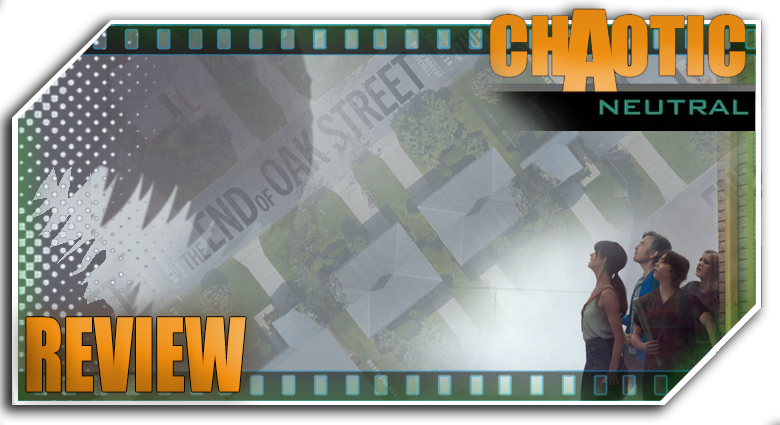
Spiel’Burbs: ‘OAK STREET’ has zippy zip-code but fails to ‘soar..
It’s the 1980s and Oak Street seems like a decent place to live. Most of the neighbours are fine (even if there’s always ‘one’!) and the families that live there get by as best as they can.
Denise and Greg Platt are muddling through, though their marriage is starting to feel the strain of trying to meet all their hopes, dreams and financial commitments. So, they have other things on their mind than the strange lightshows that appear to come at night or the plants that are beginning to sprout up in their gardens.
But one day, those changes become too big to ignore. Oak Street appears to have moved – not in space, but in time – and now prehistoric creatures are roaming the neighbourhood… and they are annoyed and hungry.
Can the Platts pull together to survive the experience and get back to civilisation… or will this strange phenomenon tear them apart… with very sharp sets of teeth..?
It’s an obvious note to make, but The End of Oak Street feels, for the most part, like the kind of project Steven Spielberg might have produced in the 1980s (the time period in which the movie is mostly set). A generic neighbourhood and a nuclear family (with smart if reckless children) finding themselves facing the bizarre and working out their differences to survive? This was the go-to template for tentpole titles. In the years since, Spielberg’s works have been much copied and even the master himself hasn’t always lived up to the mantle, even when on familiar territory (Yes, Disclosure Day, we’re looking at you…)
For a while many believed J J Abrams to be Spielberg’s heir apparent, but though he’s created some notable pop-culture moments, he hasn’t quite lived up to the heights some predicted. Here in a producer mode, there’s definitely a sense of familiar territory.
The clutch of influences are not hard to see. The dinosaur aspect obviously encourages comparisons to Jurassic Park and the film actually does a better job of integrating the danger of the creatures into the story than some of the more recent set-piece-heavy entries in that franchise. But there’s also some gene-splicing from other DNA strains… the recent The Last House also centred around a family who are trapped in their home when something bizarre happens to the wider world – though that film generally felt much darker. There’s also a few Stranger Things and Back to the Future moments along the way. As cinematic law dictates, there’s also a canine-saviour in the mix.
But there’s a sense that The End of Oak Street has been designed by a committee on a zoom call, one that isn’t quite sure which of those zip-codes they want to inhabit and the avenue they want to emulate. There’s a lightness of touch for the most part, with ‘behind you!’ moments, toilet humour, predictable foolish choices and various prat-falls, yet there’s also some far more serious and bloodier punctuation as neighbours meet untimely fates. There’s certainly a moment before the last act begins where you start to think that the entire film might have wrong-footed you and is about to get far more bleak.
The Platts are a broad-stroked cinematic family. With the exception of a superfluous neighbourhood girl Jeannette (Jordan Alexa Davis) to which the script gives a handful of lines in the expectation she’ll be pivotal and then… little else, it’s interesting that the female characters are given far more steel than their male counterparts. Anne Hathaway is Denise Platt, the frustrated housewife who is secretly writing a novel in the basement with a central figure that dreams of escaping the disappointments of suburbia while her daughter Audrey (Maisy Stella) follows the ideas of Carl Sagan and has a solid grasp of cosmic concepts and scientific theories. On the other hand, Ewan McGregor’s Greg is a well-intentioned but largely aimless father who has lost his main job and is delivering pizzas to make ends meet and fully aware that his family unit is becoming strained and with a son Brian (Sweet Tooth’s Christian Convery) clumsily navigating the adolescent tribulations of smoking and school bullies.
In the tradition of popcorn romps, pay no attention to some of the inconsistencies that the high-concept generates if you stop to ask too many questions or the throwaway lines of hand-wavery science which will disappoint those looking for more solid explanations. (Indeed, the resolution could generate a Mesozoic migraine…) The 80s setting produces a decent soundtrack kicked off by Pat Benatar and it helps with a sense of convenient nostalgia that also explains the lack of wider communication tools of the 21st century. However, a few moments of abject violence and a scene where the Platt’s awkwardly find two dinosaurs in the middle of a Jurassic coitus subvert the for-all-ages label that might otherwise have felt appropriate. It’s another aspect of a film that initially feels skin-deep generic (which is fine), but then wants to be something more… and isn’t.
The End of Oak Street has so many rich veins to choose from that it could have been a classic in any of them. But the fact it cannot decide which seam to mine and ultimately gives disconnected lip-service to as many as possible, makes it feel not like a bad film (it will pass the time pleasantly enough) but a series of wide-mark missed opportunities. One can imagine an Amazing Stories or Twilight Zone occupying the same real estate in half the time for an outcome that’s twice as good.
7/10
The End of Oak Street is now available on digital platforms…