

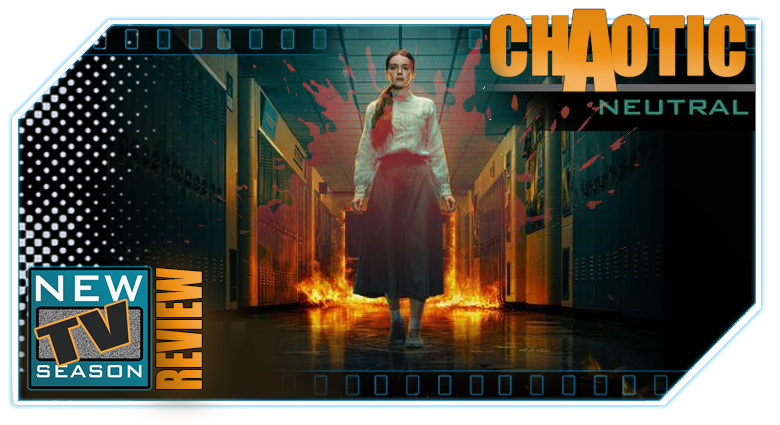
CLASS ACT: Flanagan’s bully-pulpit makes CARRIE chilling and timely…
Carrietta White has not had an easy life. Her father, Ralph, was a prepper, believing every conspiracy theory and her mother, Margaret, is a religious zealot afraid that ‘Carrie’ will not be able to handle the outside world’s evils.
But when Carrie’s father dies, the state sees the conditions in which she’s being raised and insists she start public schooling. It is not a transition that goes well.
The home-schooled Carrie is smart but completely naive of the wider experiences of her potential peers. Teachers try to make Carrie feel welcome, despite Margaret’s stern interference on what and how she should be schooled, but the young girl quickly draws the fickle ire of school bullies and it’s not long before Carrie’s experience of her first period forms the mainstay of an exploitative social media account named Carrie Red.
It’s the machinations of Queen Bee Chris Hargensen, a girl with privileged family problems of her own as her daddy’s business fails… and Chris and her acolytes are determined to make anyone who doesn’t worship at her feet pay the price.
But while Carrie might seem an obvious, helpless target, she comes to realise she’s far from powerless. As the temperatures rise, the community – students, teachers, parents and the media alike – select their sides and their preferred versions of the story, but it also starts to tear itself apart.
We know how it ends.
We’re going to learn how it started.
The 1976 version of Carrie, directed by Brian DePalma and with Sissy Spacek in the title role, is a pretty high benchmark for a certain type of horror. One can argue that in the years since special-effects have got better and that there are more bone-marrow breaking chillers, but there’s something primal about the horrors of high school and satisfying about an underdog raining down bloody vengeance on her tormentors that goes far beyond the traditional slash and hack. Perhaps only Buffy Summers has bitten into that vein with the same degree of generational angst and with far less actual blood.
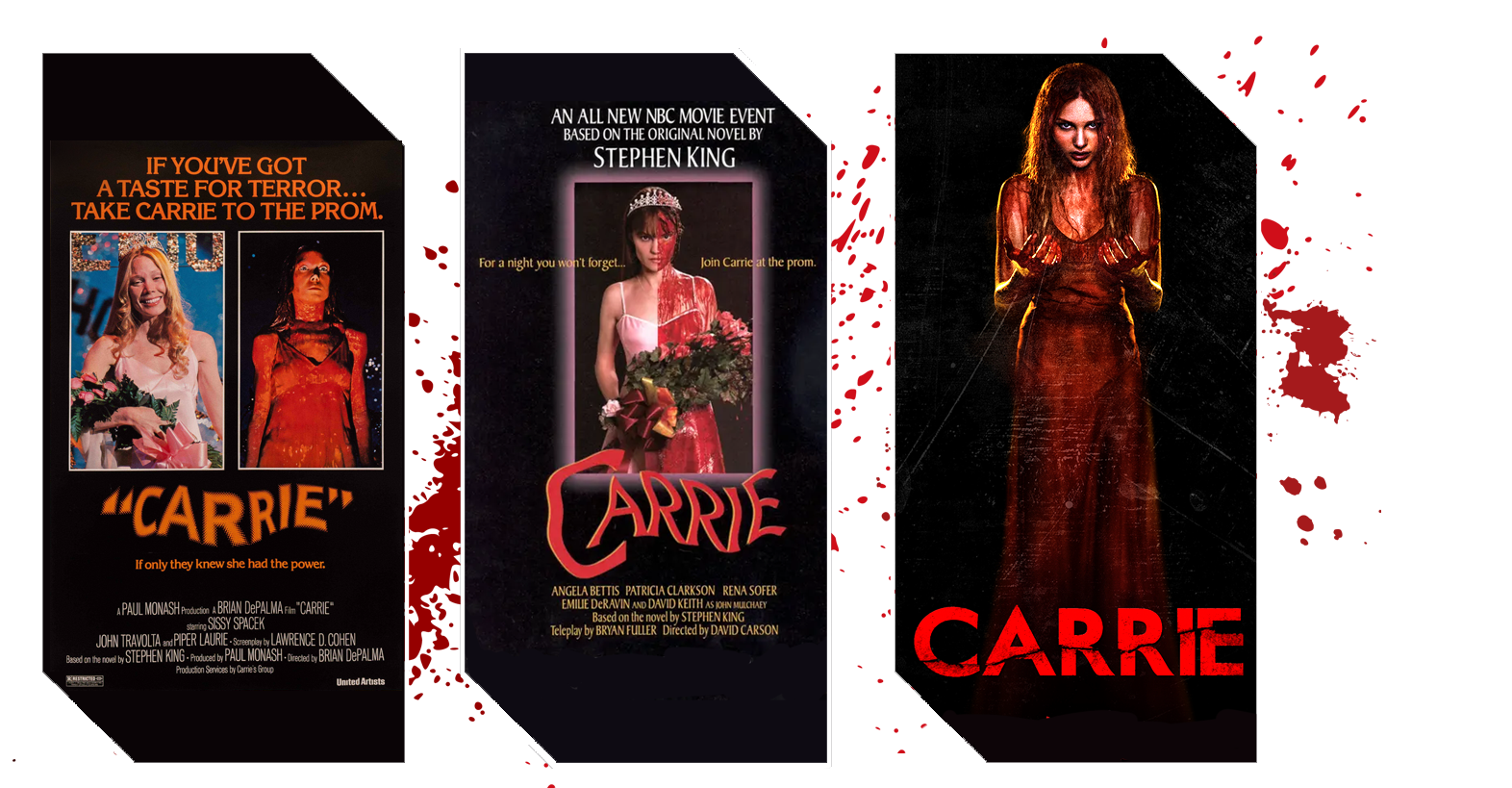
Remakes/continuations have been produced allowing Carrie to carry on. There was a 1979 sequel entitled The Rage: Carrie 2 (which was just as opportunistic as it sounds) with Emily Bergl, an NBC tv movie in 2002 was penned by Bryan Fuller and starred Angela Bettis( but was largely panned by critics) and 2013 brought us an acceptable cinematic rerun of the story with the capable Chloë Grace Moretz (and Julianne Moore as her mother).
It feels like a story done and told. But once you attach the name Mike Flanagan to proceedings, you know may have to reevaluate. Not only has unapologetic King fan and collaborator Flanagan managed to produce solid adaptations of the author’s work that are applauded by King himself, he’s also created benchmark suspense and horror in his own right (Honestly, The Haunting of Hill House and Midnight Mass are simply essential viewing).
But skill-set aside, the main factor remains: how much can anyone remake Carrie without simply treading the same ground with a different flair? The answer, Flanagan shows us, is to map the territory but then modernise the conceit and expand the implications.
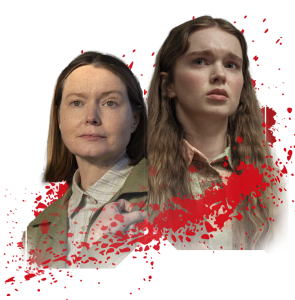 The casting of Carrie White is the crux around which everything pivots. If the centre doesn’t hold, nothing else will. Spacek’s original placement in the legacy is largely untouchable. But Summer H. Howell is quietly outstanding in a role that requires elements of quiet and fury. She makes the character sympathetic to the audience but it’s also understandable when classmate Sue Snell quietly admits to her boyfriend that despite the support she sometimes wants to slap Carrie for being quite so helpless in an environment that is often combative. Carrie, of course, isn’t helpless she’s just sheltered and totally unequipped to face a world from which she’s been kept… but is about to break free.
The role of Carrie’s mother is a Lady Macbeth-level creation, but one that can easily devolve into pantomime wickedness. Samantha Sloyan – another regular member of Flanagan’s ensembles – once again proves her participation credentials, making Mary White every inch the infamous religious zealot full of resentment and holy brimstone but also an object of pity – perhaps something of a victim-turned-abuser, herself.
Alison Thornton makes Chris Hargensen a screen bitch for the ages, but she and the script give her some meat on the bone. Nothing excuses her actions or decisions and the consequences they ultimately bring, but Thornton gives a performance in which we can see the pain and fragility behind her empire of dirty tricks, the way her life has been shaped to bring her to the abyss.
Siena Agudong as Sue Snell, the young student caught between day-to-day popularity and doing the right and better thing, captures the turbulence of general High School. Like the previous version, she personifies the few people who genuinely care but who aren’t equipped to deal with what they are forced to face. Josie Totah gives her manipulative and toady Tina an Iago-esque thirst for recognition. Thalia Dudek’s Emaline provides a new wrinkle in the story and helps steer Carrie for better or worse.
Others in the supporting cast also excel, in particular the school staff who are faced with a mix of the usual everyday dilemmas and the more unusual mounting tensions. Matthew Lillard as Principle Grayle is a guide trying his best and it adds another layer to an actor often known for his more light and comedic roles, Amber Midthunder (excellent in the Predator revival Prey) gives frustrated teacher Miss Desjardin an edge. Another Flanagan regular Rahul Kohli makes teacher Seth Peist a pragmatic realist, but one with his own reasons to hate the toxic memes and Tim Bagley’s Mr. Morton is a wry source of encouragement. (If you know any teachers, you’ll recognise the ebb and flow of their efforts and frustrations). Also good in ‘smaller’ but just as significant parts are Heather Graham, Gil Bellows, Michael Trucco and Tahmoh Peniket – both of the latter two famous for their Battlestar Galactica roles. (You’ll get a full-on BSG overload by the time the last episode is done!) Kate Siegel – a frequent collaborator with husband Flanagan – narrates some of the background, historical jaunts as well as directing the third episode and later coming full circle. Another actor turned director Kyra Sedgwick helms episode five. Also, see if you can find Mark Hammil in the mix! This is a seriously heavy-weight ensemble.
Most modern horror often has to find ways to circumvent cell phones and the kind of technology that would have likely saved victims in previous decades. Flanagan positively embraces them, fully aware there’s nothing more insidious than weaponised social-media and the speed of spite. Here, a facebook post is as sharp and consequential as a shiv. The story is bookended by various voices recalling what happened – with a town rocked by disaster, a school on fire and carnage in something’s wake and enabled once again by in-universe media coverage eager to find a quick angle rather than ask the deeper questions. There’s also clues in the opening episode that Carrie’s abilities aren’t someone-off freak genetic quirk or profane gift and that there may be others out there with an interest in her fate. That’s given full voice in the finale.
The tragedy at the core of the story remains a timely tale of the sheer purgatory of adolescence and how technology and social media has fed that beast and multiplied its wrath. If you’re a slow-burn horror fan, you’ll love this bittersweet tale of revenge and if you’ve ever been a teacher or a student it’s an achingly relevant, painful triumph…
While the supernatural aspects of Carrie are always flittering around the edges like funereal confetti, the slow-burn towards the inevitable sometimes means we have to deal with the more grounded dangers and trigger points along the way. There’s physical and mental battle-scars, pregnancy fears and peer-pressure powerplays that ebb and flow. There’s a brief danger in the middle of the eight episode run (each chapter named after a school-subject) where the show is so savage in its depiction of school bullying that it starts to feel more like ‘Heathers on crack‘ than a more traditional horror story, but the power of the material and Flanagan’s firm hand on the tiller suggest this is an outing that would work even without the Stephen King origins and the Dark Phoenix-style denouement. On the way to the pre-ordained ending, the story also provides off-ramp moments where we see things could have end better if people had made better decisions. You’ll likely find yourself screaming at the screen for a character to do/not to do something. Spoiler: no, it’s not going to end well. It’s car-crash tv… but in a way that boldly holds your attention and from which you simply can’t turn away.
I used to think that the screen depictions of school bullying were often extreme (and I say that as someone who was bullied)…that films and tv could be just a little too maniacal. Most kids are decent proto-people, but I have revised my thoughts to accept that there are occasional examples of real life cruelty that can border on sociopathy. So, while there are moments where even Flanagan paints the school bullies and bitches with a broad brush, it’s sadly true that while stylised for the screen, very little of what we see is unprecedented low depths.
Such a project could have gone off the rails in a multitude of ways, but Flanagan brings the basics you need, the pivots you may see coming and some twists that you likely won’t and combines them into an imperative. Yes, there will be those who have some problems with the final episode – there are some big swings and, certainly, divisive elements worthy of discussion and debate (events that, on one hand dial back some of the primal sense of consequence but also seem to be cleverly laying the groundworks for a bigger canvas of wider King works). There are too many series easter-eggs to go into here, but which could lead to more interconnected drama…
It’s now an unbelievable fifty years on from the Spacek version and longer since the original book hit shelves in 1974. The tragedy at the core of the story remains a timely tale of the sheer purgatory of adolescence and how technology and social media has fed that beast and multiplied its wrath. If you’re a slow-burn horror fan, you’ll love this bittersweet tale of revenge and if you’ve ever been a teacher or a student it’s an achingly relevant, painful triumph.
9/10
The full season of Carrie is now available on Amazon Prime…