

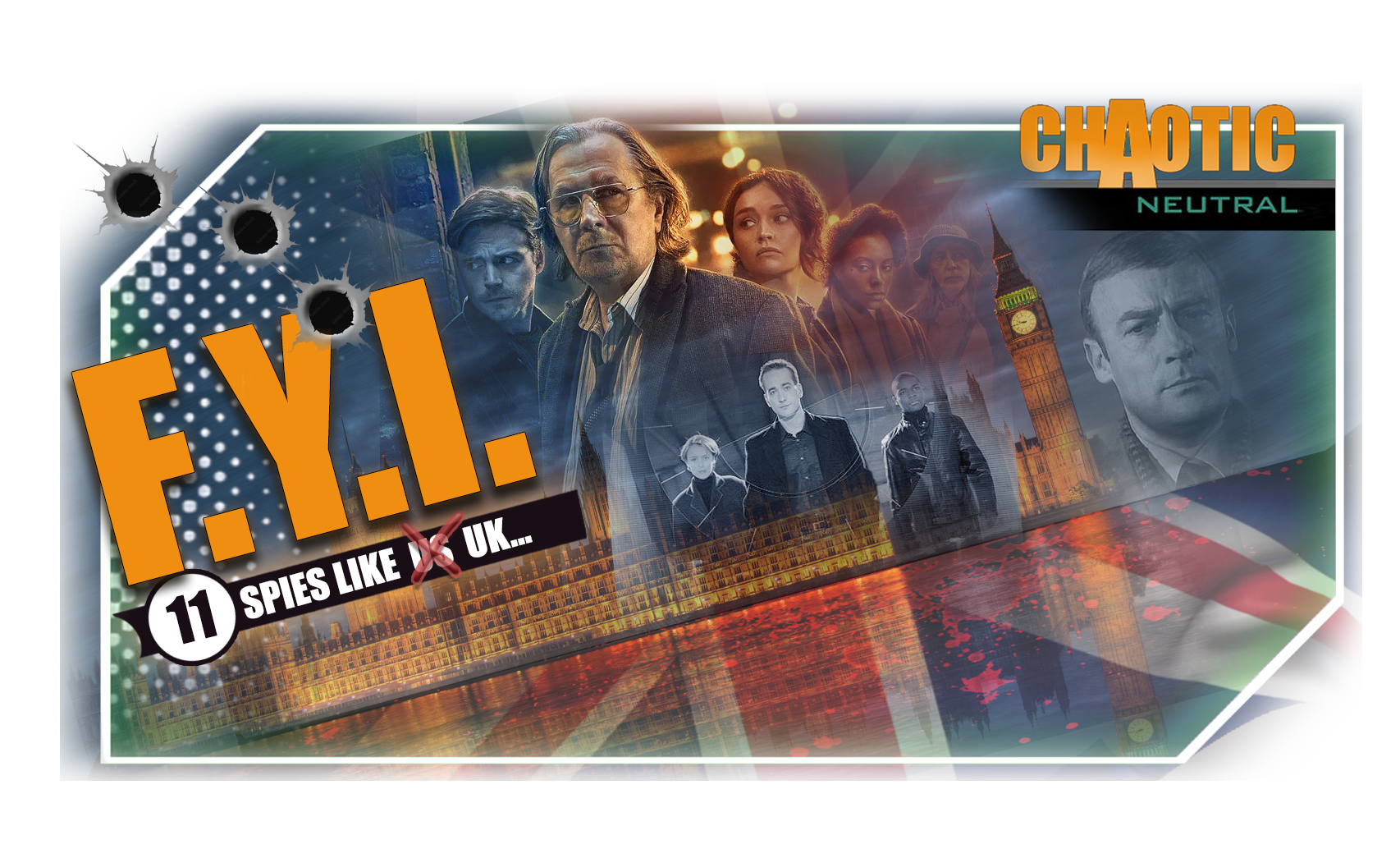
FYI-11: Agents Provocateurs…
 The industry is now actively looking to cast its next 007. But while the cinema has taken espionage to the widescreen with massive-budget extremes and US shows have always been glossy, Britain’s most successful televisual spies have long since found more success with a more grim, streetwise style. As SLOW HORSES returns, John Mosby asks: Has the spy game really changed its rules… or have we?
To some, England and the whole ‘Rule, Britannia’ vibe suggested a sense of sophistication, politeness and fair play. The reality might be much different, especially if you look at the isle’s somewhat troubled history, but in literature and drama, espionage was – for a long time – somewhat subdued, a gentlemanly veneer when facing down the most treacherous cad and even murder most foul and an Axis of Evil could be vanquished with a stiff upper lip, a cup of Earl Grey and some astute observations.
Over the years, the likes of upper-class heroes such as Holmes, Watson, Drummond and Marple may have given way to the more daring exploits of 007, but British spy dramas always seemed to retain that air of looking at the antics of other nations’ secret agents and tutting loudly.
But the interesting counter-espionage counterpoint is that while classic tales remain popular and consistently reinvented, in the last fifty years, the typical British spy series has often gone in the other direction. The societal rebellions of the 1960s and counter-culture aspects that permeated thereafter, mean that there was a pivot from high-class exploits in far off lands to the dramas of the working class – the kitchen-sink soaps and street-level stories with which people felt they had more in common, even if they were grim.
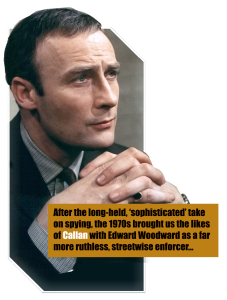 Those with longe memories will remember how much an impact that the Callan series, made on British television screens between 1967 and 1972. It actually debuted as an Armchair Theatre play entitled A Magnum for Schneider by James Mitchell. Here, Edward Woodward, years away from the 1990s US network show The Equalizer, (about a retired spy looking out for the dispossessed) played a British secret service officer charged with doing unpleasant things to keep the country safe. This was an agent with no stipend, one with barely contained rage and frustrations and more acquainted with back alleys and cheap pints than high towers and martinis. He had a ruthless remit that often included torture and violence. He had no real compunction about killing, but he was more of a rusty, sharp shiv than a traditional Walther PPK.
The memorable rogues gallery of supporting characters included Russell Hunter as ‘Lonely’ (as with Callan, we only get occasional hints at his real, given name), Callan’s informant and foul-smelling lackey. There was always a feeling of tolerance rather than camaraderie between Callan and Lonely, though they tended to look out for each other’s interests as if they were their own (which sometimes they were).
The show’s gritty approach proved popular and as well as the four series, there was also a feature film (based on the A Red File for Callan by James Mitchell which itself was actually based on the series’ first outing) released in 1974. It received mixed reviews and many critics felt it was a journeyman effort, a decent but more opportunist venture to cash-in on the success of the show than a remarkable outing in and of itself.
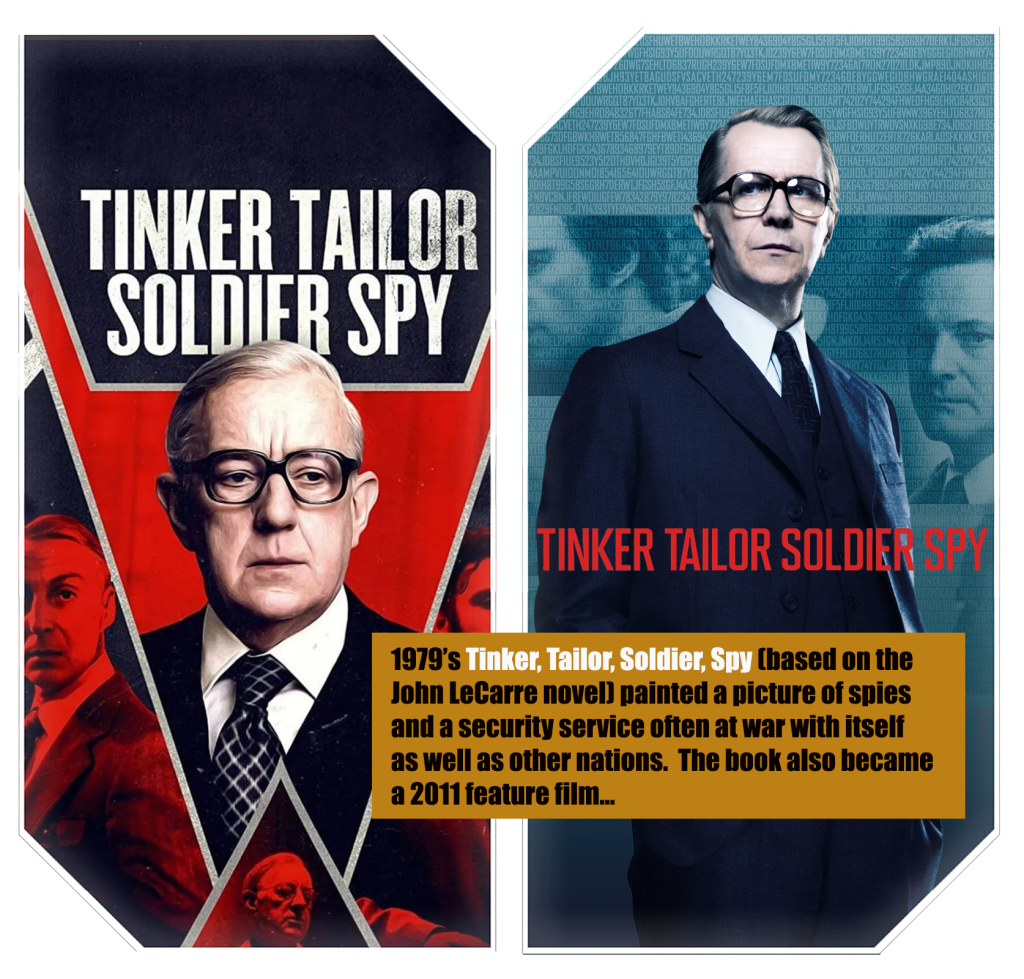 The wider Cold War continued to provide lots of opportunities for international intrigue both on the printed page and the screen. John Le Carre’s Tinker, Tailor, Soldier, Spy was first adapted for the screen in the BBC‘s seven-part series (streamlined to six on its US broadcast), screened in 1979. The multi-award-winning production featured an all-star cast, including Sir Alec Guinness as central character and spymaster George Smiley, along with Alexander Knox, Ian Richardson, Michael Jayston, Bernard Hepton, Anthony Bate, Ian Bannen, George Sewell, Michael Aldridge and Beryl Reid. It told the slow-burn tale of internal security service egos and the search for a high-level mole in the era of the Cold War. Even to this day, it’s recognised as landmark television with a story that still resonates. In 2011 the novel was adapted for the big screen with Gary Oldman taking the role of George Smiley and an equally strong supporting cast that included Colin Firth, Tom Hardy, John Hurt, Toby Jones, Mark Strong, Benedict Cumberbatch, Ciarán Hinds, David Dencik and Kathy Burke. Once again set in the early 1970s, it felt like both old-school spy tale and a saga of always relevant power-plays. One of Le Carre’s subsequent novels, Smiley’s People was filmed for television in 1982 and once again starred Guinness in the title role.
But television shows didn’t just have to be good, they had to be unapologetically commercial and also needed to attract a younger audience that were not yet hooked on high-brow classics. The likes of the influential London Weekend Television (LWT) wanted something to provide contemporary, fast-paced escapism to domestic audiences that was homegrown, rather than the raft of US network shows that eventually made their way to UK screens and formed the backbone of primetime.
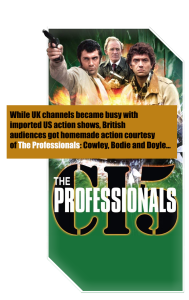 The Professionals (which ran from 1977 to 1983) was something of a hybrid show – an influential and fondly remembered tv series that became a cornerstone of UK television at the time. It was a response to US action shows that dominated screens and had lots of gunplay and derring-do to be seen, but grounded in a still somewhat cynical, pragmatic vein. Bodie (Lewis Collins) and Doyle (Martin Shaw) were the partners sent out into the field by their CI5 boss Cowley (Gordon Jackson). There would be plenty of car-chases, hand-to-hand combat and work for the stunt-team, but it rarely ventured into the more askew escapism of the American type. Collins was later seriously considered for the role of James Bond but admitted he blew his audition by being too confident that it was his to lose. (Interestingly, there would also be a less influential and more basic revival of The Professionals concept in 1999 – labelled The NEW Professionals – which only ran for one season, but featured Edward Woodward in a Cowley-like capacity).
The wider 1990s schedules continued to be dominated by medical and procedural shows (both imports and domestic) and the first beginnings of cheaper ‘reality tv’ but spies, never totally out of fashion, tended to ply their trade on the big screen or period pieces.
In the early 2000s the UK had Spooks (the name based on the slang for the shadowy secret service but renamed MI-5 in the US to avoid any colloquial racial offense) a show created by David Wolstencroft that redefined the workings of national security as a mixture of dangerous pragmatism. It wasn’t quite as ‘street’ as Callan – the Cambridge accents and Queen’s English were often in evidence – but it was still a cynical and often ruthless show, pulled from the headlines (sometimes even ahead of them) and picking the brains and skills of some unnamed consultants with a background in the security services, it quickly made its mark.
 “Part of the original pitch was that we could open a newspaper and read a headline on page two (say… ‘Five nabbed in drugs raid in Wilsden‘ but the truth is it’s actually linked to the headline on the front page ‘Terrorist cell found in Brighton‘). It’s all a set-up. It’s not knowing where the ‘iceberg’ is. The second episode of the first season was about the Far-Right and Immigration. It was actually how the Left were using the Far Right to appear more ‘central’. The episode finished its broadcast and the lead item on the 10 O’Clock News was ‘Tougher stance on immigration from Tony Blair…’ You didn’t know where the programme ended and the news began…” Wolstencroft told me when we met at a cafe (surely a covert front?) in Los Angeles to discuss the show’s impact. “We lucked out when the BBC really got behind it from the very beginning. The marketing push was extraordinary and very welcome. (The creation of the show) was pre-9/11 so nobody knew how contemporary it was going to be. We could actually start telling the stories that we really wanted to – rather than fantasise about them. We thought ‘Wow, that’s cool, we get to make the series we want‘. Normally you have an idea for a series and then they say ‘That’s great! Can you make it for five pounds?’ At every single stage it was a case of ‘value added'”
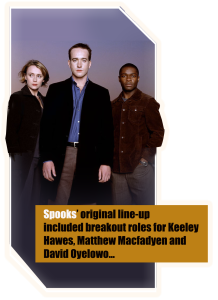
As well as the plausible deniability angle, and the ‘outside your window, but just around the corner’ feel to proceedings, the series became infamous for unpredictably and savagely cycling through a changing cast (initially including the likes of Matthew Macfadyen, Keeley Hawes, David Oyelowo, Jenny Agutter, and Peter Firth and Lisa Faulkner) in which even the above-the-title names couldn’t be assured a long character life. As a post-watershed show (ie: shown on the BBC after 9:00pm and considered more ‘mature’ material), there were still a string of early complaints to the BBC switchboard when one of the central characters in the show was killed off in only the second episode (murdered by that aforementioned Far Right figure who pushed an operative’s head into a deep-fat-dryer and then shot them – just to be sure) , but Wolstenscroft also wryly noted that the reported ‘jamming of the BBC switchboard’ may have sounded dramatic, but it sometimes took as little as three simultaneous calls to do so. Despite the wringing of hands, the show continued to increase its ratings each year – ultimately running for ten seasons and a 2015 movie. That being said, that surprise early fatality still echoes down as a game-changer for tv discomfort.
“The idea was that it got darker and darker and darker and you. As a viewer, were wondering where it would stop. Surely it would stop ‘there’… but no. You don’t see much really, though they went to town on the (fryer) dub. All you see is a bit of strawberry jam on the forearm and that’s it. But people started saying ‘Well, I’ve never seen anything like it on television..!’ Well, you still haven’t…” Wolstencroft mused with a smile. “… but we had to make it as shocking as possible. These were genuinely nasty people. We had to make the moment work, otherwise it was just another generic show where you are bound by the rules of television…”
The Spooks: The Greater Good feature film did not push any new boundaries and an ill-fated, high-concept spin-off (Spooks: Code 9 – filmed in Leeds and Bradford and set in 2013 after a nuclear device contaminates London and with secret service operations now moved north) was barely connected to the original, aiming at a younger audience. However, the main, original show remains strong and stands up to the test of time with all seasons available on DVD.
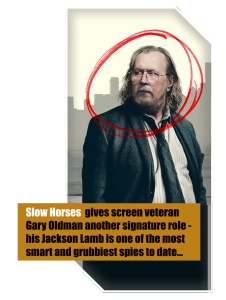 If Callan and Spooks had a honey-trap love-child, it would surely be Slow Horses (based on Mick Herron’s acclaimed Slough House novels). It tells the story of cases involving a governmental office of outliers… all sent to the poorly-equipped base of operations for varying degrees of infractions and largely seen as the first, best line of deniable collateral damage rather than defense. The tv series boasts the talents of ex-Smiley Gary Oldman (as seedy but strategically-savvy boss Jackson Lamb) and his group of outliers, few of which Lamb would to spend any social time with (and vice versa). Half Columbo, half-Smiley and definitely all cheap wine, it’s easy to see why Oldman took the role and ran with it. The series has just returned for a sixth season, with a seventh season already filmed and an eighth confirmed. (It’s one of the few examples of a show with a winning formula that also seems to have got its schedule sorted well in advance…)
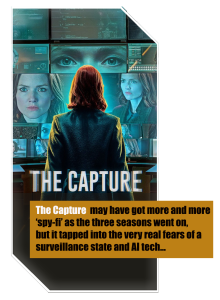 A glossier series and one with better tech, is The Capture detailing the machinations of a governmental department concerned with deep fake shennanigans via ‘Correction’ (the ability to manufacture electronic ‘evidence’ to make sure bad people skirting outside the limits of the law end up paying the consequences). The first series was a twisty in the sense of both narrative and morality and one of the few shows where I genuinely couldn’t guess ahead of time what would happen to whom. (A recently released squaddie exits prison after he’s acquitted of killing an enemy combatant who may have surrendered first but then the soldier is captured on a London street camera, supposedly showing ‘live’ footage, assaulting his barrister, something he claims never happened – so what did?). In an era of deep-fake claims and rising concerns over AI and governmental overreach, it was a timely series that asked all the right questions if unable to provide all the answers. A second season – showing that ‘Correction’ technology could even be used to alter ‘live’ broadcasts on the tv news – increased the threat and the topicality of ‘fake news’ claims and raised even bigger questions about how far tech could go. A third run, broadcast earlier this year, may have continued the trend of raising the stakes to paranoid extremes regarding surveillance and twisting the truth – and (hopefully) firmly in the specualtive spy-fi folder, but it was still a conspiratorial delight that made sure you’d never look at a close-circuit camera in quite the same way again.
In recent times, America has given us more iterations of high-flying, globe-trotting Jason Bourne, Jack Ryan and Ethan Hunt
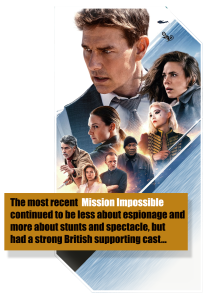 The original Mission Impossible series of the 1960s (complete with that classic Lalo Schifrin theme music) dealt with operatives solving international problems without their enemies sometimes aware of how they’d been thwarted or by whom, but the movie franchise (starting in 1996 with Brian De Palma as director and then moving through the likes of John Woo, J J Abrams, Brad Bird and Christoper McQuarrie in the chair) quickly became all about sheer spectacle and scale. In an obvious effort to out-do Bond Tom Cruise jumping from every vehicle possible in the most picturesque and dramatic locations. The most recent entry – the seventh feature in the franchise, Mission Impossible: Dead Reckoning – was purported to be the last, though don’t put money on that. Though most of its characters survived the machinations of an AI intelligence, they barely survived the slef-indulgent plot. This was less about espionage and more about especially dangerous stunts, a showcase for the boundaries a VFX department could push and how far a star would go out on a literal ledge for the sake of a set-piece. However, it made decent money and there’s still talk of what comes next (a return to basic espionage rather than big existential concerns, please?).
So, finally, what of the king of spies, the timeless James Bond – currently in the process of regenerating like a Time Lord once more…
Over the years we’ve seen numerous incarnations, from the rough-around-the-edges and not always likeable original of the Ian Fleming novels through to Sean Connery’s testosterone’d alpha-male to the eyebrow-raising antics of Roger Moore who even took the agent into space. George Lazenby got a brief swing at the character and Pierce Brosnan personified the 1990s rule of suave and fun. Timothy Dalton and the latest Daniel Craig were probably closest to the source material. It will be interesting to see the tone of the next chapter. Idris Elba (an early favourite) ruled himself out, but at the time of writing Slow Horses actor Jack Lowden appears to be on a shortlist.
What seems a given is that while the world remains a treacherous place with competing agendas and sometimes unpredictable leaders, spies will always have their place… whether over-the-top or willing to patrol the gutter…and while the UK version might be less glamorous and often less-financed than some, they still have a particularly engaging set of skills.