





THE LAST HOUSE: captive viewing, doesn’t hold water…
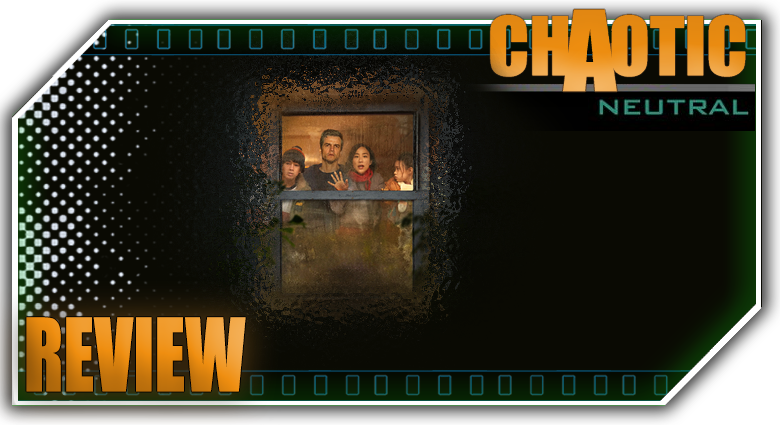
In a Seattle suburb, Jason Delgado finishes a day fishing from the nearby pier and returns to his family… it begins to rain but as they plan a trip out together, something strange happens. The front door is jammed. So is the back door. So are the windows. Suddenly, there’s no way out.
The family can’t make sense of why, but they begin to realise the whole area – and possibly beyond – is in the same situation. When not searching for a way out, people hold up placards to send messages from window to window, sharing what little they know.
But whatever caused the phenomena and whatever still lurks outside, some of the most pressing problems are within the homes. For the moment, the family has food and water and enough supplies to hopefully ride out the bizarre event.
But time passes, resources dwindle and the family has to decide the difference between survival and truly living…
As a character-study in watching a group gradually handle ‘the stresses within from a threat without‘ The Last House starts well enough, taking a normal day’s mundane activities and watching them fracture in a suddenly confined space. Confusion takes hold. Routines initially change in the way that, say, an inconvenient power-outage might ruin your afternoon – suddenly you have no way to use your pc, watch tv or even recharge and use your phone. You have to talk to people in front of you! (It’s a 21st Century problem, but the hurt is real!)… but the problems cascade as more time passes and the walls close in. Conveniences and essentials become more distinct as it turns from minutes or hours into days, weeks and beyond. How’s your food and drink supply? How can you get information? Is there a way to get out of the current situation? The film shows a family cope in different ways and only drip-feeds what may have caused the problem to begin with.
The cast are up to the task of charting the trials and tribulations. Wagner Moura (best known for and his Academy-Award nomination for The Secret Agent and his role as Colombian drug lord Pablo Escobar in Narcos) is Jason, the practical father who takes up the mantle of shifting the family into survival mode and tries to take the weight of that protective role at the expense of niceties. Greta Lee (A House of Dynmaite, Tron: Ares) plays his wife Ann as more of the emotional core of the family, trying to hold everyone together. Their kids, Ruth and Graham (initially played well by Riley Chung and Noah Alexander Sosnowski respectively) are relatively normal offspring – navigating a world that they’ve taken for granted until now.
The Last House is a good-looking movie but despite its interesting premise and early promise, this is a familiar neighbourhood that ultimately feels as if it has vain aspirations for a better zip-code. Its apocalypse-adjacent tale has a structure that can’t settle comfortably on its foundations… and it takes you a moment to notice, but you’ve been here before…
Despite being helmed by Louis Leterrier (a director more accustomed to bigger and more kinetic canvasses such as The Transporter, Fast X and The Incredible Hulk), there’s a distinct feeling that this is the kind of film, penned by Matthew Robinson, that fluttered its way across M. Night Shyamalan’s desk or at least parked in his vicinity. Shyamalan’s Signs (2002) was about a farming family tackling alien invaders (despite the aliens had a weakness that made Earth a piss-poor and illogical target in general). 2004’s The Village saw an isolated community fearing what lay in the woods nearby. His later outing, The Happening (2008), saw a global environmental shift that caused chaos for humanity while never establishing the imperative at its heart. In 2023’s Knock at the Cabin Shyamalan adapted Paul Tremblay novel about a young girl and her dads being held hostage in a rural building while something really bad ™ for the world happens – mainly off-screen. The Last House glances in all those directions, takes notes and – despite flipping some of the conceits to work better – doesn’t really learn to avoid other pot-holes or blend them evenly or tonally.
But this is another film with a starting premise rather than an all-encompassing rule-book and the closer you look, the more the cracks, seams and exceptions start to show as it looks for consistency and logic. We learn quickly that the offending precipitation is involved in creating a transparent surface that surrounds all buildings, making exit impossible…yet that seal veers between absolute and arbitrary (the family’s efforts are thwarted but they do locate a potential gap that shouldn’t be there in such conditions). The internet and television go down but the electrical grid lasts far longer than you’d expect with lighting a’plenty. Equally, even in suburbia it feels like there’d be more people left outside – but we get token figures who are little more than collateral damage. The actions of the outside force also feels to be determined by the scene’s needs… is this a prepping motion picture with an environmental angle or an action monster movie? I won’t spoil the ending, but there’s definitely a sense of ‘really?‘… given what’s gone before and the questions over the film’s events and their wider impact.
The Last House is neither terrible nor memorable and could do with losing about a quarter of its running time. Frustratingly, there’s a far tighter, less effusive, possibly more nihilistic and more interesting film to be made here, one that doesn’t have to spend a chunk of its budget explaining (and showing) the whys so much as the basic consequences of a destroyed status-quo. In real life, COVID-19 made everyone reevaluate their limits amid isolation and the way that the other houses in the Delgados’ street initially form a fragile support network feels more dramatically worthy of exploring than things that go drip in the night. If released five years ago, in the wake of the pandemic, The Last House might have felt more on the nose. Here it’s playing catch-up to a society already back to battling with attention spans.
For a film where water plays such an important part this is less of a deep dive and more hard to fathom.
7.5/10
The Last House is currently on Netflix…