





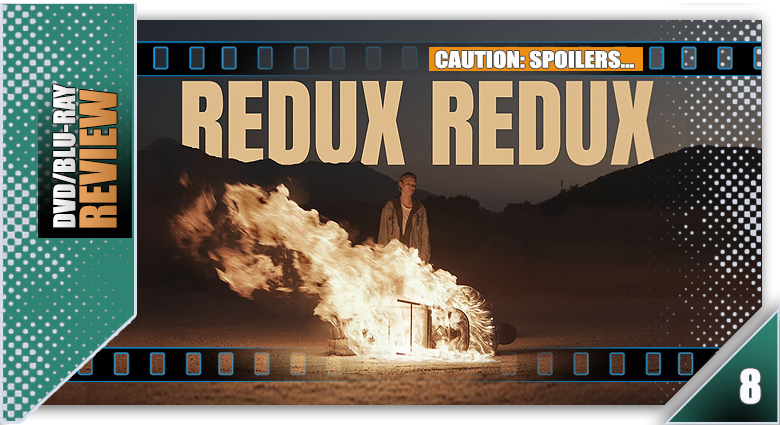
ALT-DELETE? REDUX-REDUX gives a genre-twist on revenge…
Irene Kelly lost her daughter to a sadistic serial-killer and couldn’t even find the body to bury. She punished ‘Neville’ but didn’t find any answers. However, Irene’s homeworld appears to be the only dimension that has discovered the secrets of multiverse travelling and so she acquires the technology to move between dimensions and pursue the different variations of Neville to do one of two things: find the truth or kill him again and again.
But after thousands of such trips through interchangeable realities there have been no answers, only repeated bloody retribution. In all the worlds, the local versions of both Irene and her daughter are dead and the ‘prime’ Irene has almost given up hope of anything but this cycle of primal ‘justice’…
Then, on one such cycle, she saves a runaway named Mia from Neville’s clutches – and all Irene’s carefully-laid plans are thrown into chaos…
*some spoilers*
Alternate history or multiverse movies often pivot around the differences between the worlds they depict and to which a person travels. It’s a way of exploring the fantastical, the variations on a theme, the fundamental or extreme ‘What Ifs’ of life, the universe and everything. So, one has to give Redux Redux its due for deciding to reprioritise the concept and bring it down to Earth – or, arguably, a collection of them. As we follow Irene through her nihilistic mission through multiple ‘here and nows’, the focus is not so much on the things that change, but the things that remain the same. She gets infinite do-overs though the outcomes usually only differ slightly in (literal) execution.
But it’s the streamlining here that saves on both budget and scale, the idea that you can tell a smaller more personal story against the backdrop of something bigger. The opening imagery is powerful and you want to know where it will go next. It’s inverting The Terminator concept and making the time-bending killer the righteous one – to a point.
Michaela McManus may be the sibling of the film’s directors, Kevin and Matthew McManus, but is well-cast and here on merit. You’ll likely recognise her face from series such as Law and Order: SVU, SEAL Team, The Orville, Aquarius and current hot-topic Memory of a Killer, but not so much that she carries too much baggage going in. Her version of Irene is akin to a T2 version of a hardened Sarah Connor, a person with such a specific mission that she blinkers everything else out and sees no alternative to losing her humanity by attrition. The difference here is that with the losses she’s experienced, she completes her mission every time, yet keeps continuing her visceral revenge on a ‘repeat’ cycle through different realities – originally convincing herself she can find a world where either there are clues to where her daughter’s body ended up or – better – her daughter lived, but (after apparently experiencing 1000s of variations and little new information) the repeated revenge on ‘Neville’ has become the bigger imperative. McManus makes the audience understand Irene’s drive and fury but also lets us see the tail-spin of personal consequence that we want her to escape.
Relative newcomer Stella Marcus arguably has a breakthrough role here as Mia, the young girl whom Irene manages to save from Neville during one of her trips. Initially, Irene tries to simply put her on the road back to a better life, but Mia’s rebellious nature and adolescent anger brings chaos to Irene’s set-routines. Mia’s desire to punish Neville may not be as fully-formed as Irene’s own, but it’s primal enough that Irene is forced to bring Mia along to protect her from her own impulses. It’s interesting to see a sisterhood/mother-daughter dynamic develop, though you’re rarely sure it’s going to end well.
House of Cards‘ Jeremy Holm takes the role of Neville, but though his actions drive the story’s mission statement, he’s really the maguffin of the piece – an easy to hate, sadistic character but one where you never really find out much about him other than the effect he’s had on others.
 There’s some wider world(s)-building around the central idea of moving between dimensions. We do learn that there appears to be only one world that’s discovered the steampunkish tech to go sliding through different realities – Irene’s original world – but it’s mostly reduced to a side-plot where Irene needs a new part for her ‘chamber’ and has to reach-out to other dark-web and dubious ‘travellers’ who make a nice sideline in the supply-and-demand of those ‘passing through’.) That part of the film feels like it could have been another story entirely. However, the film is actually better when it waves away those elements. There’s nary a whiff of a Loki or Victor Von Doom scale of cosmic consequence or imperative in the idea of dimensional travel and its bigger implications. A majority of the threats are simply the dangers of all-too-human darkness and the spiralling effect that basic revenge can incur.
The film avoids many of the pitfalls and contradictory headaches that a more basic time-travel story and its rules would bring, though – putting on my nerd hat for a moment – there’s an argument that if some of the variant scenes we see echo earlier ones (but rely on the idea of Irene or Mia making slightly different decisions) then there are some time-loopish elements in the mix. The deja-vu repeat-visits to the diner where Neville had a side-job could be simply put down to revisiting a location that would legitimately barely change from day to day, but a scene outside at a PTSD-anonymous meeting where Irene makes a connection/tries to with the bumbling Jonathan (Jim Cummings) is lensed and written in a way where it feels like the same night with different outcomes (though she refers to one ‘visit’ as having lasted two months with him). Ultimately Redux Redux shifts between the learn-through-living-different-outcomes of, say, Groundhog Day and the darker landscape of Zodiac.
There’s a possibility that Redux Redux might have been tighter as a slightly shorter entry in a standalone anthology like Black Mirror (The McManus Brothers were actually nominated for an Emmy in 2018 for their subversive entry American Vandal but lost to the Black Mirror entry USS Callister) or even expanded out to incorporate other wrinkles in the dimensional displacements. The DVD cover might also suggest a more action-orientated outing, but though there’s car-chases, gunfire and some bloody deaths along the way, Redux Redux turns out to be a more cerebral story, one that doesn’t fit neatly into traditional momentum-driven outings. That’s actually a plus.
However, as a study on both revenge and its cost, it’s a solid, interesting take on the genre and if you missed its brief theatrical-window earlier this year and its appearances on the festival circuit, it proves a pleasant subversive surprise: an under-the-radar, worth-watching DVD/blu-ray release that keeps you looped in and emotionally-invested.
8/10
REDUX REDUX is released by Sony Pictures Home Entertainment on to DVD and blu-ray on 5th May and is also available on multiple subscription-based VOD platforms.