


FYI-12: Captain, my Captain. Remembering Sir Patrick Stewart…

From his early days as a reporter in Yorkshire, Patrick Stewart’s journey took him from the Dales to Deep Space and his passing this week leaves a unique hole in the firmament. John Mosby laments a fellow proud Yorkshireman, recalls their interviews and looks to the roles that allowed the theatrical knight to reach for the stars, to go boldly yet remain grounded and still make it so…
Almost impossible to comprehend, Sir Patrick Stewart was 86 when he passed away this week. For a man who certainly achieved the commercial heights of his career in the latter part of his life, he also seemed… not young, but a mainstay, unchanging and constant. Bar a few inevitable wrinkles that came with that furrowed brow and magnified by his shaven head, he really hadn’t changed in appearance for decades and there was a feeling that he would always be here, with the longevity of a cinematic Mount Rushmore. Certainly, no-one would have thought that his fellow Enterprise captain, William Shatner (now aged 96), would somehow outlive him.
So, the news of Stewart’s death hits particularly hard – not only because he essayed such significant pop culture icons (Star Trek‘s Jean-Luc Picard and the X-Men‘s Professor Charles Xavier) of my youth and adulthood but because he was also a proud Yorkshireman who initially split his time between early interests in journalism and a passion for treading the boards. Years (and his considerably greater acting talent) might have separated us, but we literally saw the same hills, rode the same trains and eventually flew to further lands (while always remembering where we came from).
I met him a number of times, including promotions for his screen work in London and events in Yorkshire.
“My first job was as a very junior, not to say infantile, reporter with the Dewsbury and District Reporter. I stayed there for two years until the rather formidable editor Henry Wilson gave me an ultimatum. l had submitted a report on a council meeting that I was supposed to have attended the night before. I had actually been at a rehearsal and my contact had phoned through all the copy to me,” he once explained to me. “Mr. Pickles, the sub- editor, asked if my copy was right. ‘Not very eventful was it?‘ he asked. I agreed. ‘Not very eventful at all in fact?‘ I agreed again. He was curious that I’d failed to mention… that the major woolen mill, right across the road, burned down towards the end of the meeting! l was given the ultimatum that I either gave up all my amateur dramatics (l was working simultaneously with about six amateur societies) or quit the job. l walked upstairs, packed up my typewriter and told my friends I was going to be an actor… all out of spite.”
Needless to say, Stewart never really regretted that decision and agreed that, in all honesty, he has owed Henry Wilson for the ultimatum that shaped him. Somewhat against the advice of his colleague, friend and companion-in-shenanigans, Sir Ian McKellen, he ould ultimately decide to try his hand at screen work in America and his career blossomed.
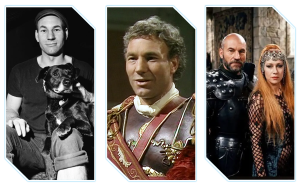 His screen roles might be headlined by the obvious, but he appeared in Coronation Street, Play for Today, made an early mark in I, Claudius (as Sejanus), Tinker, Tailor, Soldier, Spy (as Karla), those of a certain age will just as much enjoyed his Leondegrance in 1981’s Excalibur and as Gurney Halleck in 1984’s version of Dune. He was a delicious Maitre D’ at L’Idiot in 1994’s LA Story and essayed an assortment of villains, some of which were worthy of his talents. His voice was also instantly recognisable and as well as providing the inflections for projects such as The Prince of Egypt , Jimmy Neutron: Boy Genius, Chicken Little and frequently lampooned himself on the likes of Futurama, The Simpsons and Family Guy.
Famously, Sir Alec Guiness was frustrated that his years of more ‘serious’ stage and screen work became eclipsed by the cultural juggernaut that Star Wars became, but Sir Patrick became far more satisfied with his Star Trek work and the knowledge that it would be a significant part of his legacy.
He got the role of the new Enterprise captain Jean-Luc Picard over the initial reluctance of franchise creator Gene Rodenberry, who had originally conceived the character as more ‘young and virile’ and an obvious successor to Star Trek: The Original Series‘ mainstay James Tiberius Kirk (William Shatner). But many of those involved with the creation of Star Trek: The Next Generation have repeated that after a lengthy audition process no-one came close to performing as well as Stewart and he first appeared in the role on Monday Sep 28, 1987 in the pilot ‘Encounter at Farpoint’. The series ran for seven seasons and 176 episodes.
True, Jean-Luc Picard was a more formal captain than James T. Kirk and Stewart approached it that way, though always felt that the ideas of duty and service didn’t obscure the man beneath.
” I was I was continually hammering on the producer’s door in the first two years saying, more jokes, more jokes for the captain. He is not a jokester, but I felt that he was too serious, too solemn, perhaps, and that he needed lightening up a little bit. But humor has always, I mean, it’s one of the most attractive aspects of the way Bill developed Captain Kirk, because there was always this willingness, this irony, a raising of an eyebrow, which suggested that not only the character, but also the actor perhaps wasn’t taking all of this TOO seriously.,” Stewart offered. “It’s true that he didn’t often get angry or violent, but Picard is one of the most passionate individuals that I’ve ever played… with strong feelings about what he does and how it should be done with a deeply emotional connection to his senior officers and staff, a powerful feeling about his ship and a great sense of duty and responsibility. And those feelings are built on passion. He loves literature, music, dancing, writing and so forth. So, I don’t think he was ever, ever a cold man. I think he was detached and removed and I think he was private in many aspects of life, much more certainly than Captain Kirk. ”
“I think that we didn’t drag our feet in that we were never content… I was never content to simply regurgitate the same old fellow in the same old situation time and time again those times that stand out. Inner Light, in which the captain is transported to another time frame and another world, lived 40 years of a totally different life in the space of 35 minutes back on the Enterprise. That gave me the opportunity to plan a life for this man if he were no longer part of Starfleet but we’re living in an ordinary small community somewhere with a wife and children and grandchildren. That episode was also very important to me because of the first time that my son and I worked together. Daniel was an actor and he played my son on the episode. Measure of a Man, which was when a scientist from Starfleet came on board the enterprise to study and analyze data, and with a senior staff decision that Data would be taken back to Starfleet, dismantled, examined, put together again, and then thousands of copies of them created and the discussion in that episode was one of individual liberty and a person’s right to make a choice about what happens to him. In other words, was Data property? Was he owned by Star Trek or was he an independent creature? He was a machine and not human, but did that deny him the basic human rights that the rest of us have? This is typical Star Trekstuff, you know, and one of the things that gives it its richness. My personal favorite episode is not one which I have very much to do is an episode called The Offspring, in which the android Data creates a child for himself – another brilliant performance from Brent Spiner. But it has a lot of performance from our guest star, a young actress called Hallie Todd [ as the] child android… the other one would probably be the second part of Change of Command, which was a two-part[episode] in which I was kidnapped by the Cardassians and subjected to the most brutalized form of torture and interrogation by a Cardassian (played superbly by the British actor David Warner, with whom I had not worked since I played player king of his Hamlet at Stratford)…”
“I’m just another authority figure! Since I was a teenager, my career has been littered with kings, captains, emperors, party-bosses, trade union leaders, presidents, generals… you name it, I’ve worn the uniform. In X-Men, I’m a mutant leader. What’s truly ironic is that I’m the least authoritarian figure you are ever likely to meet…”
On screen, Picard actually survived Kirk with Shatner’s Captain coming to an end during a battle with Malcolm McDowell (ironically, another Yorkshireman!) in 1994’s big-screen Star Trek: Generations which also saw characters from both arms of the franchise coming together for the first time. However, there was little satisfaction for Stewart in escaping any metaphorical cosmic shadow. He’d actively campaigned for the captains to meet.
“Oh, I have been a passionate advocate for that to happen from the first time the film project was projected. I thought that if we missed the opportunity of combining the two crews – but most particularly bringing the two captains face to face – we’d miss out on a very good trip. Bill’s background is theater. He’d worked at Stratford, Ontario. He’d worked on Broadway, done classical… That’s definitely the same for me. So, we found when we got to know one another that we had much in common,” he explained. “In the earliest version – because we shot two completely different versions of the action climax of the movie – Bill, in fact, ‘died’ in my arms. In the [final] version, of course, he dies under some kind of steel. To my surprise I found [Kirk’s death] rather poignant. It was early evening in north-eastern Nevada as I ‘buried ‘ James T Kirk. It was actually in a state park called The Valley of Fire and we’ve been told that the park has since been swamped with visitors looking for the burial site. ”
Stewart was an obvious choice for the role of Charles Xavier, the folically-challenged mentor to a group of mutants with special powers that led them protect humanity and yet be shunned by it. That Shakespearian gravitas and a willingness to be involved in fantasy as well as his presence and physicality. To match him against his old friend Sir Ian McKellen as ‘Magneto’ ( a ‘supervillain’ but one driven by the atrocities against himself and his people in the likes of Auschwitz) was an added bonus.
“In all the years we spent together at the RSC, Ian and I only worked together on one production and that was only a few days’ work. We are of a similar age and our careers have grown together. We come from the same part of England and in many respects, we have similar backgrounds. To find ourselves playing those two linked characters in the X-Men was a total delight.”
“Just look at a picture of Patrick next to Xavier – there’s an obvious similarity admitted director Bryan Singer during publicity for The X-Men. “But much more importantly, Patrick is an incredibly talented actor, his voice, presence and his ability to understand the material made him perfect for the role…”
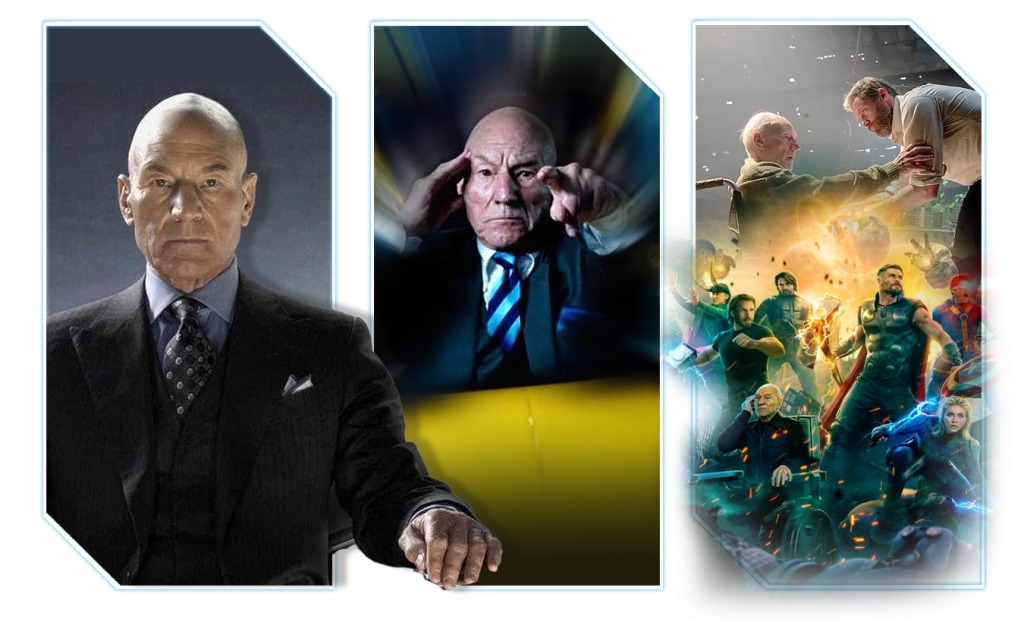 “I’m just another authority figure!” Patrick laughed. “Since I was a teenager, my career has been littered with kings, captains, emperors, party-bosses, trade union leaders, presidents, generals… you name it, I’ve worn the uniform. What’s truly ironic is that I’m the least authoritarian figure you are ever likely to meet.”
(Some might disagree. As self-deprecating and charming as Stewart could be in the moment, he would admit his personal failings, didn’t suffer fools gladly and as well as famously standing up to Singer on-set over the director’s behaviour towards fellow cast-mates, he was also well-known for stating his mind, he held grudges, his strident inclusive politics and holding his ground on such and his real-life role in supporting organisations that were aimed at preventing violence and abuse, both of which he had experienced from his own father).
 Adding to the list of titles, he officially became a ‘Sir’ in 2010, for his contributions to drama and said that he would be celebrating his knighthood with Cecil Dormand, the teacher who first encouraged him to consider acting as a viable profession.
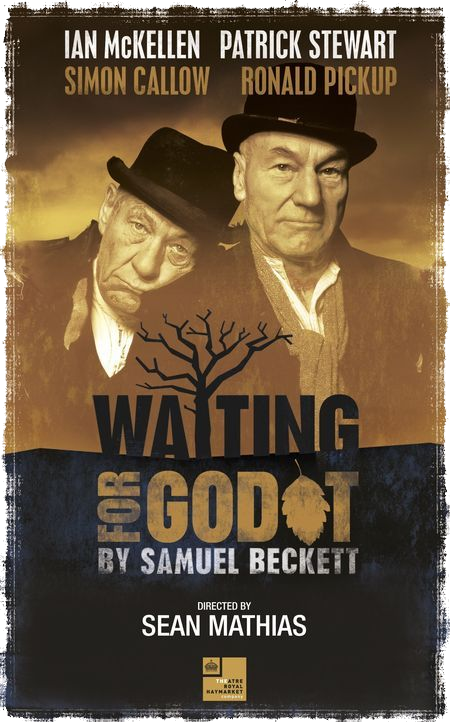
An assortment of projects on both stage and screen would continue. His love for A Christmas Carol saw him appear in a 1999 made-for-TV film version and years later he took a one-man show of the story on tour.In 2022, he uploaded a series of videos onto social media of him reading the story. He also toured in the UK and US with McKellen with Samuel Beckett’s two-hander play Waiting for Godot.
After The X-Men, X2, The Last Stand and Days of Future Past, the R-rated Logan was supposed to be the final outing and swansong as Xavier for Sir Patrick (and Hugh Jackman as Wolverine), a magnificent, brutal outing best viewed in the optional black and white. However, they would both be tempted back with Stewart essaying alt-versions of the character for Doctor Strange in the Multiverse of Madness and Wolverine and Deadpool respectively. Stewart will present his final appearance as Xavier in Avengers: Doomsday alongside Sir Ian McKellen in December.
In recent years, Stewart continued to work, though his public appearances decreased since 2024. He gave a final outing for Picard in three seasons set after his character’s ‘retirement’ and was willing to send up his persona and beyond those previously-mentioned animated outings, appearing as a pompous version of ‘himself’ in Ricky Gervais’ Extras and famously went toe-to-toe with Star Wars‘ Mark Hamill in a series of Uber-Eats commercials.
In July he spoke to TV Insider and said he would continue to work as long as he was able…
“As any actor my age will tell you, there are fewer and fewer available roles as we get older. That being said, I still continue to receive interesting offers and I love being challenged by new work,” Stewart said at the time. “I can’t imagine ever officially retiring. I’ll always and forever be an actor.”
The announcement of his passing came via his family: “We announce with great sorrow the passing of Sir Patrick Stewart yesterday at his home in Los Angeles, in the loving care of his beloved wife Sunny, following a brief and poignant journey with Alzheimer’s Disease and Lewy Body Dementia. He has been held in the warm embrace of family and friends, surrounded by live music, prayer, tears, laughter, and the kind of profound emotion that only he could inspire after a lifetime of devotion to us all”
It also included an excerpt from his memoir, which read:
“Like me, Jean-Luc has lived in an unusual life that has taken him far beyond the bounds of normal human experience. But he is also someone who has remained true to his earthbound roots, for they are what gave him his identity. In the end, he feels the call of home, as do I.”
As news of his death spread, there were thousands of heartfelt tributes from fans and colleagues and friends.
William Shatner, who had already spoken about the loss of fellow Trek actor Walter Koening (Chekov) in the last week, lamented: “What a heartbreaking week it has been. Sir Patrick Stewart was a friend, a colleague, and a magnificent actor. From the stage to the bridge of the Enterprise, he brought intelligence, grace, and a deep sense of humanity to everything he did.”
“Sir Patrick brought Professor Charles Xavier to life with extraordinary grace, intelligence, and humanity, defining the character for generations of fans, from ‘X- Men’ to ‘Logan’ to ‘Avengers: Doomsday.’ He was a singular talent, a generous collaborator, and a true gentleman,” Marvel Studios said in their statement.
But perhaps McKellen’s tribute best summed him up:
“America was his adopted home, where he met his adored [wife] Sunny who has cared for him through sickness and health, through thick and thin. But he never forsook his origins: and the proudest achievement of the most respected and beloved actor of his generation on either side of the Atlantic, was his appointment as Chancellor of Huddersfield University in Yorkshire… Before everything else, Patrick was defined by being born and bred in Yorkshire, the proud county in the north of England which he loved to the end. You could hear it in his accented voice and in the stern honesty with which he told you what he thought and felt. Yorkshiremen have no truck with half-truths or avoidance of big issues. He wore his heart on his sleeve, which made him a man to rely on, to admire and in my case, love.”
Per his family’s wishes and in lieu of flowers, memorial contributions may be made to: