

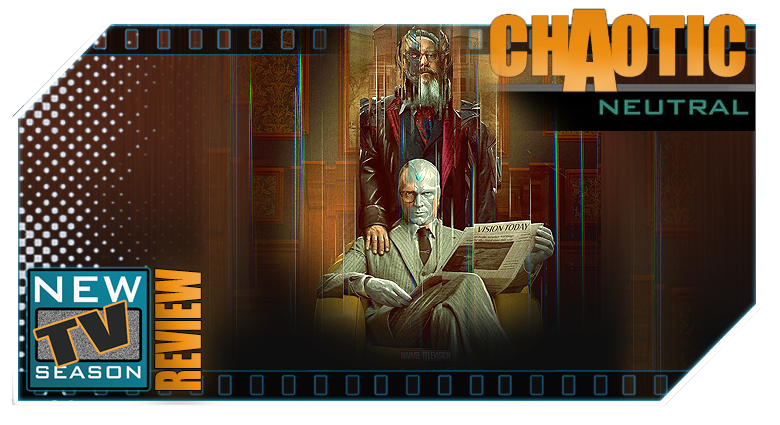
Shade and Freud: Was MARVEL/DISNEY+’s VISIONQUEST a shrink-wrapped wrap-up..?
The Vision was a synthetic ‘human’ whose personality came into being through the motivations and machinations of Tony Stark, Bruce Banner and their creation Ultron. Vision may have sprung almost fully-formed, but it was through his love with another Avenger, the Scarlet Witch Wanda Maximoff that he began to find his place in the world.
However, the rise of Thanos caused great tragedy and Vision was murdered by the Titan and that plunged Wanda into a depression and a psychosis that would lead to a multiverse of madness. Eventually a new version of the being known as Vision formed, one that did not have all the ‘feelings’ of the original, but who managed to absorb all his forerunners memories.
Now that version of the Vision also seeks to find his place- both externally in the ‘real’ world and through the artificial assistants he has within his consciousness. And the avatar of Ultron him/itself.
The mixture of magic and technology can seem to do the impossible and that means that the Vision may, impossibly, have human offspring.
But now someone else knows that… and starts to use it against him… and Ultron is ready to find his own place…
“To feel envy is human, to savor schadenfreude is diabolic.”
– Arthur Schopenhauer
That may be true, but let’s say that VisionQuest certainly ponders both the shade and the Freud.
Marvel have had mixed success with their various MCU series. Sometimes that comes down to pacing, sometimes down to accessibility of the characters and sometimes to a feeling that they were simply marking time between the feature films.
The ‘Vision Trilogy’ is an interesting subsection of that universe – three different but consecutive series detailing Vision’s place in the world after his life (and demise) in the Avengers movies, his romance with Wanda Maximoff, her (possible) demise and the synthezoid’s after-life in a new ‘body’, trying to work out how much of the ‘Ship of Theseus’ remained. (Not all series entail you researching Greek mythology for that metaphor, but consider this a bonus!).
VisionQuest was ssentially a pondering on the nature of existence, identity and fatherhood… with a smattering of action and good helping of discussion on AI often with a stylised delivering system which was both inspired and sometimes too clever for its own good. A case of not saying much, but saying it in shiny 4K.
For the first half of the opening episode, it did feel like the show was running an extended, continuous ‘Previously on...’ intro. There were two obvious problems with that. Firstly, it speaks to the sheer complexity of the Vision / Wanda history and it’s hard to distill the back-story down into something coherent for a ‘newbie’, so much so that it ends up being a barrage of clips from the previous films and shows and endless exposition. Secondly, you’re probably not here by accident. Despite its qualities, VisionQuest would be an absolutely horrible place to jump into the story and few are likely to attempt it – this was a series for the already-invested, a virtual bookend to a volume of an even larger saga.
Early on, there are some stylistic, cultural frustrations. Much in the same way that British people know that all Americans wear cowboys hats, US audiences clearly still believe the quaintness of British locations and so Edinburgh is still pronounced ‘Edinbro’ to US viewers and the obligatory quaint thatched pub still has a haycart being driven past in the opener. At least it has electricity.
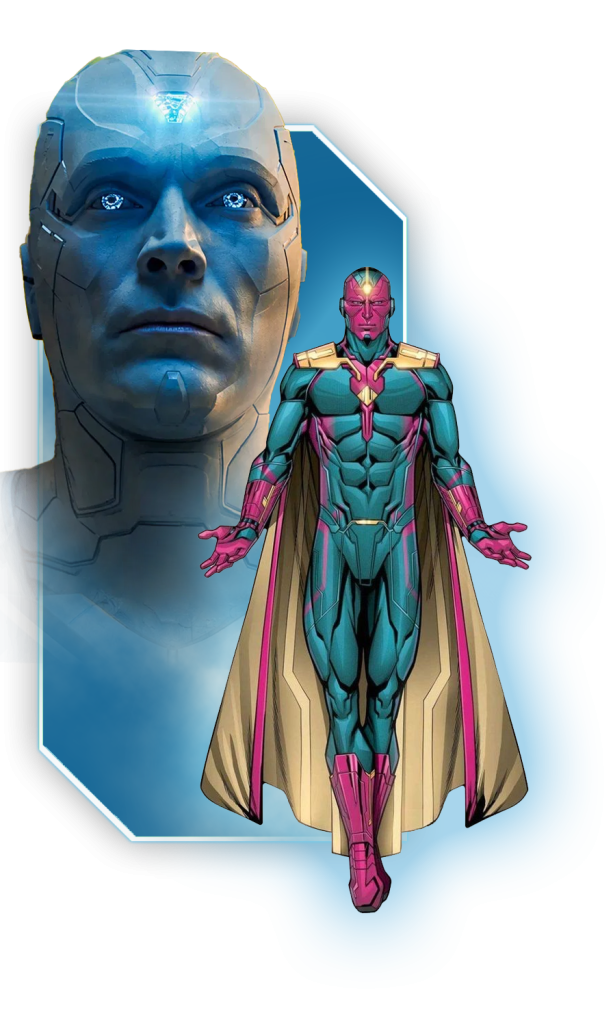 Most of the initial info-dump is distilled by a VFX inner-monologue in which the various artificial intelligences we’ve met along the way are all saved and filed within Vision’s subconscious and seen as recognisable avatars who handle different aspects of his ‘personality’. J.A.R.V.I.S. (James D’Arcy), E.D.I.T.H. (Emily Hampshire), F.R.I.D.A.Y. (Orla Brady), D.U.M-E (Henry Lewis), U (Jonathan Sayer) all play their parts. But just when you thought this was going to be no more than an AI version of a transcendental group therapy session, VisionQuest starts to open up from its infinite Rubik’s Cube of an existence and raises the stakes out in the real world.
One of the people rallied against him is Paladin. Todd Stashwick has fun with anything he’s in (we’re still waiting for him to be resurrected for a much demanded Star Trek spin-off) and he instantly makes his Paladin a bad guy we’re going to like watching (even if his battlefield ‘costume’ looks like it was bought at Goodwill). Paladin, a title that Stashwick’s version has inherited from a long line of righteous bounty hunters, is a killer but he’s also a pragmatist (he bemoans the needless collateral damage of one of Vision’s associates thanks to a recklesss henchman, yet doesn’t even flinch in then terminating the offending henchman with extreme prejudice).
Bettany is the anchor and he gives it his all, personifying various different versions of the character and with a clear , eye-popping (somewhat literally) devotion. Without such a performance to ground it, the series would likely be far more ephemeral. The loquacious James Spader is always fun to watch and to listen to. He’s played some superior anti-heroes and all-out villains over the years. After voicing the role of Ultron in the Avengers: Age of Ultron movie, he’s now allowed to escape most of the motion-capture and be the human avatar of said bad guy…and the script gives him plenty of scenery to chew and banter to broadcast. He has the vocabulary of a dictionary and the weary tone of Dorothy Parker. He may or may not be planning to kill everything and everybody – but, hey, nobody’s perfect.
After the set-up, the second episode was better balanced, with perils inside Vision’s head and outside it, there’s some solid enough action to parse through the inner monologues and we get a sense that the ‘real’ and the ‘virtual’ are both up for grabs. After a brief glimpse in the first episode, Ruaridh Mollica makes an impact as Thomas Shepherd /Tommy Maximoff and we see how a life of fairly petty crime put him at odds with some rather nasty examples of supposed law enforcement, but also Lauren Morais’ pickpocket Lisa Molinari and gives us some real sympathy for his dilemma.
Showrunner Terry Matalas (most recently at the helm of Star Trek: Picard) ran proceedings and brought in a clear love for the characters. However, subsequent episodes were enjoyable but mixed. The literal inner-workings and virtual landscape start as clever conceits but there are plenty of times when the viewer has to mentally pause and wonder if what they’re seeing is in the ‘real’ world or not. Particularly in the final couple of episodes, some of that real/virtual gameplay doesn’t make a lot of sense.
VisionQuest is ultimately an earnest endeavour which asks a lot of decent questions and provides some decent set-pieces, but turns naval-gazing into its own subroutine and there are times when it’s little more than a confusing, if vividly-illustrated pontifications on the father-son relationships. As noted, it’s caught somewhere between being the ‘last part of the trilogy’ – previously made up of WandaVision and Agatha All Along, an off-shoot of Doctor Strange and the Multiverse of Madness and the active preamble for the upcoming Avengers: Doomsday.
In the end, well…it’s all a bit of an indulgent mess – not without charm, humour and spectacle but a story that, by turn, often feels over-complicated, simplified and with less to say about things than the decorative nature suggests. The finale, though it provides some key, fun moments, feels like something that’s painted itself into a corner and is merely using the ‘with a bound he was free…‘ exit strategy/solution that begs you to think profound thoughts and yet not do so too deeply. By the time the credits roll, there’s certainly the feeling that a better, more streamlined take on the subject could have been told in half the running-time.
Given the likely board-sweeping events of the next Avengers movie, there’s also a nagging feeling that this could merely be a fun but self-indulgent tidy-up rather than a natural springboard with real ramifications. Will the Vision finding his ‘self’ have import beyond those credits of the final episode and appear in the feature film? Well, after eight episodes we DO get to a mid-credit scene with HUGE ramifications and another piece of the Doomsday puzzle. As for the wider VisionQuest supporting players and their hard-won fate… the pesky magic 8-Ball suggests you ask again later or maybe move on.
7.5/10
VisionQuest is now available on Disney+