


FYI-8: Game Changer, Slipped Discs…
 The evolution in technology has continuously affected the entertainment industry, often improving capabilities and resources. But in the last week, two announcements from SONY look set to have huge ramifications that bring customer care and their rights into the spotlight. With digital media in the ascendant, John Mosby asks: Are you buying the product or are you buying the argument?
It might be a sign of the times, but SONY‘s announcements about the future of their game releases still came as a surprise to many on Wednesday… not perhaps for it happening but in the sheer consequences of a double-whammy over the last week alongside with their stance on certain film titles. There’s little doubt that the ramifications will be seismic…
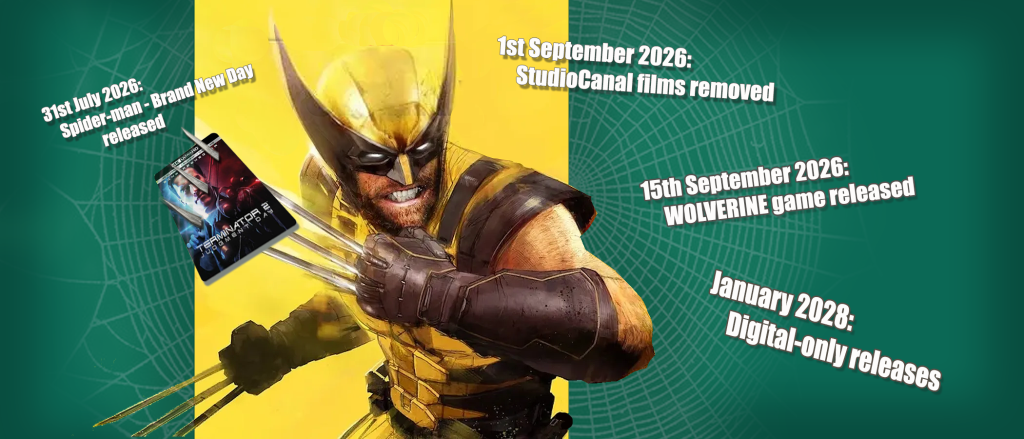
The company has confirmed that as of January 2028 they will no longer be releasing games in a disc format – instead, all their future titles will become download only. Sony Interactive Entertainment are citing consumer trends and the public’s seeming preference for digital releases rather than physical media. Their statement continued: “… We’ll continue to prioritize our resources to drive innovation in how players can access games and provide choices as to where players prefer to purchase new games, whether that’s at retailers or PlayStation Store. We remain committed to delivering a world-class gaming experience to our fans and we thank you for your continued support…”
It’s certainly true that with vast improvements in internet speed and mass-media, it has become increasingly easier to download materials (be it music, movies or games). The advantages are obvious…
Where once you had to travel to a local retailer to get a physical disc (or order it for eventual delivery), the availability of high-speed services (ranging from local domestic suppliers with speeds up to 100Mbps and fiber-optic mapping offering multiple times that) means it is now possible to buy, download and stream things far more quickly – going from days to hours and minutes and from the comfort of your own home, never having to even leave your couch. With more interconnected technology, titles are now often available through multiple devices in a home. You can watch a movie in whatever room you want and even simultaneously on several screens. It also enables wider transport through mobile devices, so you can take a whole library of titles with you when you go away on holiday. You can carry your entertainment universe in your pocket. Size, does indeed, matter.
 SONY‘s announcement over their switch to digital only games might be notable, but in and of itself it was always going to happen at some point. (In PlayStation’s 2025 Fourth Quarter financial report, the company revealed that 85% of games sold on its platform were now purchased digitally rather than physical media). So, such developments are somewhat inevitable – you can no more hold back digital technology than you could bemoan the printing press for making text available to the many or for websites eventually cutting into the news and magazine markets or the telephone (smart or otherwise) replacing the smoke-signal or the telegraph. After all, DVDs themselves replaced video-tapes and audio-cassettes. Ask your grandparents.
But as with all aspects of evolution, the way things change – and the sheer speed – can be problematic. There is a flipside, a measurable downside that goes beyond the love of tradition and luddite tendencies and it’s something that needs to be addressed and catered for, one that’s becoming increasingly apparent… and it’s resulted in something of a backlash and a trumpeting of physical media.
If the move to digital-only games wasn’t significant in and of itself, that was noted last week when Sony Interactive Entertainment started notifying users that some of the movie titles they had purchased in a digital format would be disappearing from their personal libraries. This is not a case of titles leaving streaming platforms (such as departing Netflix, HBO Max etc), these are titles (including classics such as Terminator 2: Judgment Day, Paddington, Pan’s Labyrinth, Apocalypse Now and the first three Rambo films) that had been individually purchased, not merely rented – the ownership equivalent of the content on your household shelves, full of DVD boxes. Over 550 StudioCanal titles (film and television) are being removed from access on 1st September 2026 because of a change in licensing rights. While many people have questioned the fairness of paying to own something that is then taken back with no announced recompense or refund, it does seem to be a pattern that is developing. Indeed, the shift is accelerating.
The online PlayStation Store previously had a section devoted to tv and film titles but this began to be wound down in late 2021 with people wanting to purchase them through PS4 and PS5 systems – and under new terms – were directed to the ‘Sony Pictures Core‘. Those who had previously purchased titles would be able to retain them – the caveat being that this would be the status quo unless licensing rights changed. Sadly, the word ‘unless‘ is more accurately being interpreted as ‘until‘. And to be fair, while SONY is getting the brunt of the ill-feeling from their current customers, it’s a dilemma facing the likes of Microsoft, Apple and Vudu to various extents.
Despite these changes, shops and stores will likely continue to sell games – cutting physical storefronts out of the equation, even in the modern age, could be business-suicide – but they’ll be selling packages that contain marketing and download codes rather than discs. However, that severely limits the stores’ own initiatives. Customers waiting for cheaper copies are likely to be out of luck, only getting such discounts if PlayStation themselves offer them. Though a smaller situation in the grand scheme of things, there’s also the lucrative unofficial second-hand market to consider. When someone tires of playing a game for the umpteenth time (or moves to a ‘remastered’ version) or is simply downsizing their collection, they often sell the discs on. Again, that’s not really possible with digital downloads that require that one-time/already-used digital code or ID to operate. In short, you buy it, but you can’t sell it and you might not be able to keep it indefinitely. That does lead to the question of how it differs from basic rental.
On the game side, with PlayStation also announcing that they will cease operating digital stores for the PS3 and PS Vita systems from August, people are being advised to purchase such digital versions now rather than wait (though previously purchased titles should still be re-downloadable for ‘the foreseeable future‘ – again…for however much that’s now worth).
How are SONY – or for that matter, other media giants – handling the controversies as they move forward to keep their share of the market? Beyond that general press release about discontinuing disc-releases, it’s not entirely clear. It was noted by some that after the announcement came, many of PlayStation‘s related social media accounts suddenly went silent… going from multiple posts every day to nothing after the press release. It’s not the first time that usual updates have been sidelined, with PlayStation having form for going ‘radio silent’ immediately after controversial news. It likely won’t be able to stay off for long – social media is now part of life and business day-to-day reality, but it allows the company to monitor reactions without immediate responding to a restless crowd that was, only a short time, loyal to a fault.
But that’s a double-edged sword. SONY might be able to ride out the immediate storm, but there’s also a LOT of immediate sturm und drang from PlayStation users who see this as a game-changer moment, with some swearing off the system after the accumulative announcements. The scale of the change means the reaction isn’t likely to go away, quite the contrary: it’s likely to grow and that can mean consequences for the business and its shareholders. In a hugely competitive market, that’s problematic. Change is inevitable, but bottom-line profits are fickle and not forever.
On the legal front, a group called Stop Killing Games sought to formalise some legislation (the ‘Protect Our Games Act‘ through the Californian legislature that would stop game manufacturers from selling games in the immediate two months prior to discontinuing support for a game – or be obliged to offer a patch or support to existing users to ensure the product they bought would continue to function. The Act looked promising in its early stages (in May the California State Assembly reportedly backed it by 42 to 16. Unfortunately, however, the State Senate rejected the bill this week – four Democrats voted ‘yes’, three Republicans voted ‘no’ with the rest abstaining). The group is said to be considering refining their proposed bill, but there’s no guarantee it will make a difference.
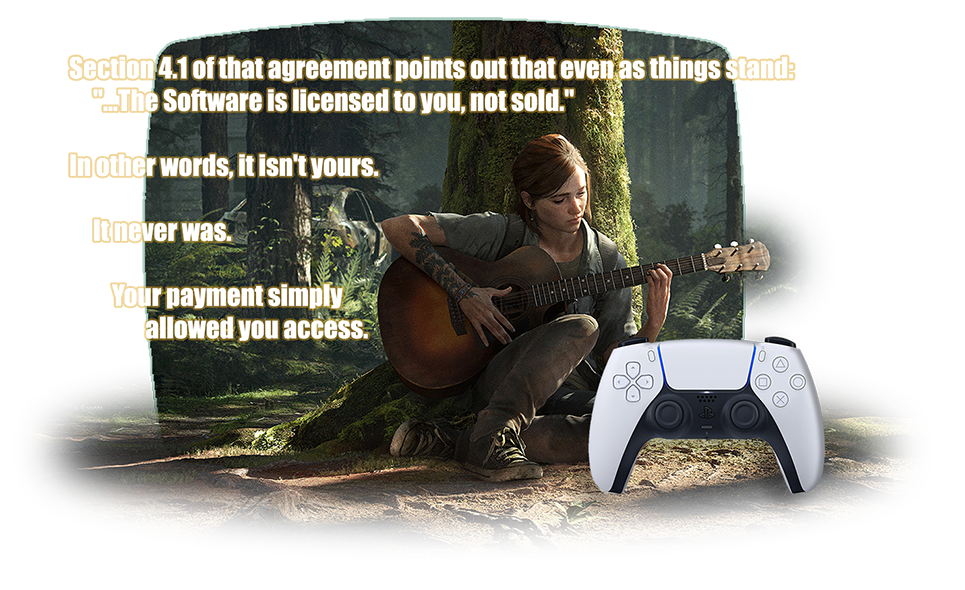 However, on the opposing side, the existing agreement already gives SONY somewhat safe harbour, at least technically/legally. They are likely to point to the PlayStation‘s existing terms and conditions which many people may not have read in detail. Section 4.1 of that agreement points out that even as things stand, “…The Software is licensed to you, not sold.” In other words, it isn’t yours. It never was. Your payment simply allowed you access.
Some have offered up the stance that if you don’t actually own something you legitimately buy then you shouldn’t be able to classify pirating a product as theft. That’s an iffy equivalency and one that would find no favour in a courtroom, but there’s little doubt that the more that legitimate businesses frustrate the customers who have previously loyally worked within the system, the more those customers might be tempted to ultimately circumvent the rules.
Some things about the imminent future are more front and centre in the sense of cause and effect.
There’s not a lot that the public can do to alter the status-quo in their favour, except vote with their wallets and feet (and controllers). However, SONY‘s attempts to hype the likes of their upcoming Spiderman: Brand New Day film has also been hit with their ‘30 Days!‘ teaser tweet viewed over 3 million times but bombarded by complaints about the physical-media decision and very few proportional ‘likes’.
The PS6, the next console that PlayStation will release, is still some way out with specifics, stats and exact on-sale date still unknown (most likely some time in 2028), but will undoubtedly be digital-only, with no need for a disc-drive. The fact that projections suggest it could be priced at over $1000 may mean that such a launch will be challenging even without the new restrictions. But add all those elements together… customers may well balk and walk. That being said, other consoles (such as X-Box which may launch the Project Helix console in the next few years ) have problems of their own and are rumoured to be following suit, meaning a radical, literally industry-wide, game-changing era is likely to be nigh – however you get your multimedia. Many businesses, aware that change is necessary, will be looking closely at the SONY/PlayStation fallout to see how they can massage their messaging when it comes to such decisions. But there’s no mistake – those decisions ARE coming and changes are inevitable.
One final observation is that Thegamer.com website calculated, looking at revealed profits and units sold, that PlayStation makes $14 for every DVD version, but $28 for every digital download, so they have no incentive to drop digital pricing or commit to physical media – quite the opposite, they could earn around another $1 billion by going all-digital. The digital-only news may have been received badly by customers, but SONY shareholders reportedly found their stock climbed by more than 3%.
For now.