



SPIDER-NOIR: Black and White and Webbed All Over…
Ben Reilly used to believe that with great power came great responsibility, but he wasn’t there for the woman he loved and to whom he felt he should have been truly responsible. She died, he lived, but the costume of his alter-ego, the crimefighter known as The Spider, was packed away and Reilly now tries to make ends meet as a private detective.
For years, the public bemoaned (and criminals celebrated) the disappearance of the hero and underworld overlords such as Silvermane seized the reins of power in an era where fighting prohibition and the powers-that-be meant not just a quick buck but political influence.
However, when an attempt on Silvermane’s empire leads to the revelation of super-powered criminals in the city’s midst, Reilly is forced to retreive that costume and use his investigative (and extra-curricular) talents to find out what is going on… and whether a woman like torch-song singer Cat Hardy is a dame to die for…
Don’t get me wrong when I say that I’m honestly surprised that Spider-Noir got made. What was essentially an interesting, alt-reality character that worked on the page of a handful of Marvel Comics issues held no such guarantee that it could also clear the leap and hurdles to the screen. This isn’t, after all, an easy sell. Your hero is middle-aged. It’s set in the 1930s or thereabouts. There’s a push to film it in black and white. There isn’t… brace yourselves…a smart-phone in sight. In no way is it aimed at the youth market (usually the most essential demographic for most Spider-man related material). Would a studio really invest a not-inconsiderable amount into such a left-field take, however sly or stylish? The best one might logically have thought of was an animated aside in the What If..? saga or coverage in the Spider-verse movies.
But, instead, we have an eight-part live-action series on Amazon (a collaboration of MGM+ and Prime Video) and while not perfect, it’s further proof that if you have an interesting take and get the right talent to execute it, there’s often a pay-off beyond the more overt or obvious. In the wake of Wonder Man, the idea that you can bring in strong talent and do something other than throw costumed action-figures at each other and eschew massive VFX set-pieces to distract, there’s a viable possibility – sometimes lost not just on Hollywood but comics themselves – for success.
There is the danger that this is a one-joke idea – taking the known mythology of the Spider-man franchise and simply transposing it onto another era – but if you were to damn something for that, it would likely decimate the comics industry itself, which frankly hasn’t been backwards at coming forward with multiverse stories and sometimes fickle reinvention in recent times. And, honestly, there’s a decent argument that when you’ve seen a particular origin-story played out in similar ways many, many times, a new twist on proceedings tends to be worth checking-out in and of itself.
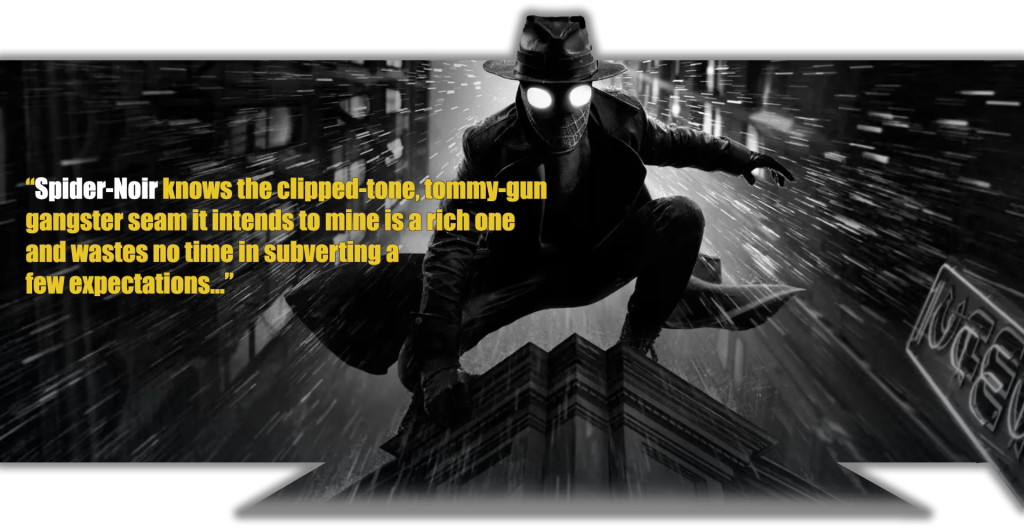
The Depression locale gives no shortage of opportunities to reinvent the wheel (or the web) and though there are nods to countless classics and more recent productions like Sin City, Spider-Noir knows the clipped-tone, tommy-gun gangster seam it intends to mine is a rich one and wastes no time in subverting a few expectations. There’s a balance between genuine menace and knowing humour – all played with a heightened spidey-sense .
There’s a lot of world-building here and in a smart marketing move, it’s possible to watch the series in colour or black and white and though both work, there’s undeniably something about the monochrome option that helps sell the adventure and needed vibe of a true yesteryear.
Star power helps. However, even Nic Cage’s most loyal fans will acknowledge that his career often varies between classics and far more disposable fare, with the actor able to go to wild-at-heart extremes. A well-known fan of comics (particularly Superman), this is Cage’s first foray into television and he acquits himself well – clearly relishing the chance to thread the needle between actual solid nostalgic drama and a broader-stroke whimsy that doesn’t chew the scenery but scales its walls. Most of the time it’s pretty restrained, with Cage making his Ben Reilly more weathered, compromised and grumpy (or as someone notes, a dick, private or otherwise) but there’s a definite twinkle in the actor’s eye that accepts he’s in on the joke, yet committed to playing it straight and starched like the screen icons of old. Cage himself described his approach to the role as “70 percent Humphrey Bogart, and 30 percent Bugs Bunny“.
Veteran Brendan Gleeson, often gloriously grizzled in any number of projects, gives us a Silvermane in the traditional overlord of the prohibition era, a cross between a street-level Kingpin and a less grungy world we saw in WB/DC‘s The Penguin. Gleeson also knows when to rein it in a little but exudes exactly the kind of casual menace the role needs.
Li Jun Li (Sinners, Wu Assassins, Quantico and The Exorcist tv series) is good at torch-song singer Cat Hardy, far more a femme fatale more than a damsel-in-distress. Other supporting roles are equally well-allocated: Karen Rodriguez (Power Book IV: Force, The Hunting Wives, The Big Leap) goes toe-to-toe with Cage as Reilly’s secretary and fellow investigator. Lamorne Morris (New Girl, an Emmy-winner for Fargo and soon to be the voice of Garfield) is strong as journalist ‘Robbie’ Robertson. Jack Huston (Fargo, Mayfair Witches, Boardwalk Empire, Kill Your Darlings) gives us a complex Flint Marko, Abraham Popoola (Slow Horses, Andor, The Rig, The Marvels) is a heavy-weight hitter Lonnie Lincoln. Witness‘ Lukas Haas (now all grown up) appears as a chief henchman named Winston. It’s also good to see Andrew Robinson (Magnum Force and famous as Deep Space Nine‘s Garak) in a smaller but interesting role later in the season.
There’s easter-eggs a’plenty, in the names of places, people and institutions, though they are of the kind that don’t interfere if you don’t get them all… and some of them have a subversive twist (including an origin story for ‘Ben’, getting his powers by being bitten by a radio-active man-spider during his WWI service overseas). The only quibbles are that some of the fight choreography feels… well, choreographed, but that could be intentional, another echo of the 30s-set cinema where fisticuffs were the art of the day.
Everyone is looking forward to the next Avengers movie (Doomsday) due at the end of the year, though equally they are growing impatient for that elusive trailer. But moving away from the conventional, expected formula seems to be working for Marvel Studios televisual aspirations, as long as they execute their productions with the quality threshold they deserve.
Spider-Noir is a tangled web that could yet weave financial and creative success.
9/10
All episodes of Spider-Noir are currently available through Amazon Prime…