


FYI: Paint it Black – DAREDEVIL is BORN AGAIN again…
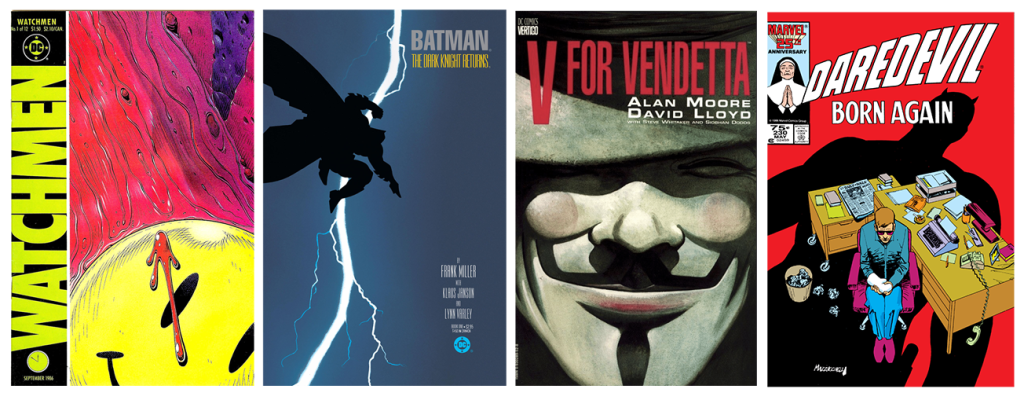
Most people grow up with the escapism of comics. However, the notion that comics are merely for kids has been challenged multiple times and with escalating frequency over the years – after all, why shouldn’t good art and good writing be appreciated when they are used together? Superheroes, once the bastion of simple ‘Zap! Thwack!’ four-colour might-makes-right fables, have long grown out of their early pulp simplicity. Even before the 1980s and the likes of collected DC Comics‘ works such as Frank Miller’s The Dark Knight Returns and Alan Moore/Dave Gibbons’ revolutionary Watchmen and another mature tome V for Vendetta (this time with artist David Lloyd) addressed the nature of both vigilante ‘heroes’ and governmental corruption and powerplays, comics have sought to reflect the more nuanced world around the reader.
Over the years we’ve had Captain America give up his role in protest (more than once) because of governmental edicts, Marvel set heroes against each other over moral stances of ‘registering’ dangerous abilities (Mark Millar’s Civil War arc, reproduced for the MCU big-screen), DC also gave audiences the character of Amanda Waller and her dubious reasons for controlling villains and heroes alike… and independent publishers have gone further.
Moral ambiguity and political subjects are part of the modern landscape and the fiction it produces – and vice versa. In more modern times we’ve also had the controversies of real-life police-officers and military personnel wearing the Punisher skull symbol (with the character’s co-creator Gerry Conway and Marvel decrying the fashion as fundamentally misunderstanding the fact that Frank Castle is mentally unstable and a murderer, no matter who his ‘righteous’ targets are).
Perhaps it’s not entirely surprising that Frank Miller – and subsequent writers – also took a subversive approach to Daredevil. After all, Matt Murdock was a lawyer by day and a vigilante by night, a dramatic narrative rich with contradictions and tensions. In the classic Born Again comics’ storyline (also of the mid-1980s) illustrated by David Mazzucchelli (and from which the current tv series takes its name and some of its elements), we see Matt’s life utterly destroyed by the gangland crime boss and long time adversary Wilson Fisk, ‘the Kingpin’, when the latter discovers his secret identity and decides not merely to kill him. It tests the limits of both men when the law seems inadequate to cope with the fall-out.
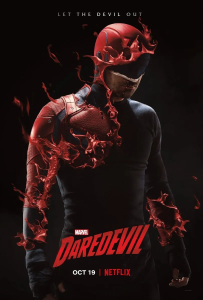 The Netflix incarnation of Daredevil starred Charlie Cox in the title role and ran from 2015 to 2018 and mined similar territory and emphasised Matt’s struggles with not just the law but his religious faith. The show was popular and lasted for three seasons and a Defenders team-up and it was only the Marvel/Disney deal and the desire by the companies to do things in-house, that derailed it.
But it wasn’t the end. Cox would briefly reprise his character in Spider-man: No Way Home and also in an ill-judged comedic cameo in the meta-textual She-Hulk show, but Disney wanted the gritty show back in some form.
The first season of Daredevil: Born Again broadcast on Disney+ in 2025 was an on-screen success but something of a mess behind the scenes with delays and a shift in showrunners during production. During filming, it was decided that it was not capturing the magic that the acclaimed Netflix run had originally garnered and that Disney wanted to emulate to some extent. The challenge wasn’t to have it be a seamless sequel, but for it to feel that way, with a few caveats thrown in. Most of the elements were there, but a course-correction was needed to get the balance right. There was no way to start again, so the eventual release was an amalgamation of sorts, taking the premise and the footage already shot and building upon it, bolstering it by changing the emphasis. Blind lawyer Matt Murdock’s titular alter-ego now turned up in the opener rather than a third of the way into the season. Karen Page (Deborah Ann Woll) book-ended the season story more importantly. Elden Henson’s beloved Foggy Nelson – and spoilers – still perished at the hands of Bullseye… but the loss was on-screen rather than coldly off-screen as originally intended.
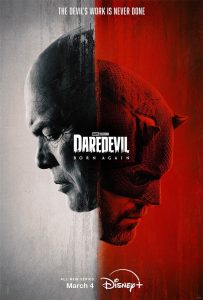 Most of it worked. The season was still uneven, but viewers and critics liked what they saw and it was clear that real efforts had been made to steady an already impressive ship – yes, these were recognisably the characters we loved and suffered with and any reason to pit Charlie Cox’s Matt Murdock against Vincent D’Onofrio’s Wilson Fisk was worth the price of admission. There were machinations, betrayals and angst galore. Throw in the Punisher (John Bernthal gearing up for his own Marvel tv movie and an important appearance in this year’s Spider-man: Brand New Day) and Marvel – and audiences – breathed a sigh of relief. Daredevil was back.
Importantly they also gave the greenlight to a second (and then a confirmed third) season and the first of those has aired three episodes over the last week, far better planned out in advance There will be blood, sweat and tears before bedtime and the necessary broken limbs and hearts around its edges.
But more so, Born Again‘s second run is important because of how incredibly timely it has become – some aspects by design, some by chance and pure serendipity.
The first season of Born Again saw an Empire Strikes Back denouement with the good guys largely beaten down and now ‘Wanted’ outliers in the Kingpin’s kingdom. The second season – with Wilson Fisk consolidating his powerbase, creating biased propaganda that claimed how popular his methods were, sending out what amounts to his own heavily-armed and thuggish task-force into the streets and navigating personal profits under colour of authority – was mostly filmed in late last year.
Which was before Minneapolis.
Now, whatever your personal politics, you’re likely aware of the real-world news within US borders. Footage emerged from Minneapolis where ICE agents were repeatedly filmed going beyond the normal procedures of border patrolling and immigration enforcement – their actions often not just tolerated but actively encouraged by the current administration who labelled any casualties as de facto domestic terrorists. You could argue about the valid need for ICE agents to be doing their primary job – but more and more people found it less easy to be comfortable with the ‘how’. and the seemingly carte blanche they had with no fear of being prosecuted. Vincent D’Onofrio has spoken in interviews about the fact the writers worried that Born Again‘s Season Two fictional events might seem too much like overreach… and admits that was less of a concern after real-life events in Minneapolis.
(No-one is actively suggesting real-life vigilantes are the solution to the problem. Dressing up as a horned street-fighter and taking on thugs likely wouldn’t do much good – though, to be fair, the inflatable frogs certainly wrong-footed troops on the ground in real life). But if Born Again doesn’t often a real-world solution, it does catch the mood of people feeling that people in power ignore laws or methods of accountability when it’s convenient to do so and the anger that inevitably comes from that.
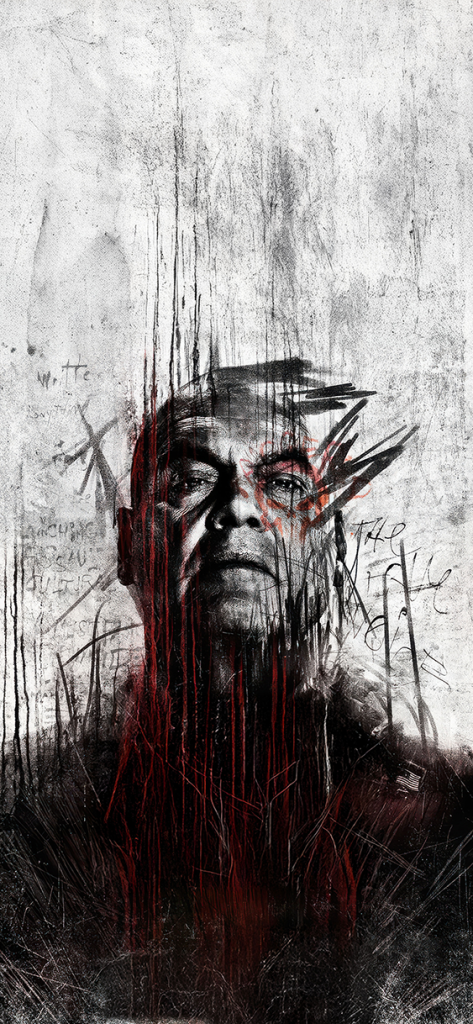 Yes, fine, it would be too easy to compare Wilson Fisk and Donald Trump, even if that’s obviously the intent on some level or at least an aspect leaned into and not avoided. (And, let’s agree – only one of them is a comic-book caricature). In truth you can point to politicians of any hue or party and find the kind of moral compromises and fluid morality that go on (or used to) only behind closed doors. In fact, it’s a saga of empires that is as old as history. The nature of power, how it corrupts and affects those who gain it and those who lose it, will always be rich territory. So, the idea that a comic-book villain is no longer a black-hat, cackling monster but a savvy operator, aware that power lies beyond fists, but more in fear, control and demanded fealty and undiluted obedience is a powerful angle to approach even if it shouldn’t be a surprising one. It looks at why and how some monsters fall and some rise… and how the cycle repeats.
Heroes are powerful icons, but villains often make the more interesting figures, unbound by conventional societal morals and guard-rails. It helps that while Charlie Cox is a strong actor and absolutely excellent in the title role, D’Onofrio is an absolute powerhouse performer, a veteran of compelling characters that never sit still nor take obvious routes. His Kingpin is an absolute masterclass in control and corruption. You may never like Wilson Fisk, but you understand him as more than his origins. Through D’Onofrio, Fisk is a terrible man doing terrible things but for internally-rationalised reasons. Through his eyes, New York needs a firm hand, HIS firm hand and it’s the chaos that Murdock and Daredevil bring against him that is the danger. Such power makes people willingly (or otherwise) bend the knee to it and those who hold it. Give such a vainglorious man the keys to the city and the chambers of power and they will not be pried from his hands without the dirtiest of fights.
Daredevil: Born Again is about that fight – the realistic, often brutal cost to both sides and the lines that will inevitably be crossed. In that sense, for better or worse, it is the superhero show of our times and, for better or worse, the one we deserve…
Daredevil: Born Again (Season Two) is on the Disney+ platform, with episodes released weekly…